01-675-820
TLR7 Polyclonal Antibody, Invitrogen™
Manufacturer: Thermo Scientific
Select a Size
| Pack Size | SKU | Availability | Price |
|---|---|---|---|
| Each of 1 | 01-675-820-Each-of-1 | In Stock | ₹ 47,170.00 |
01-675-820 - Each of 1
In Stock
Quantity
1
Base Price: ₹ 47,170.00
GST (18%): ₹ 8,490.60
Total Price: ₹ 55,660.60
Antigen
TLR7
Classification
Polyclonal
Formulation
PBS with 0.02% sodium azide
Gene Accession No.
Q9NYK1, P58681
Host Species
Rabbit
Purification Method
Antigen affinity chromatography
Regulatory Status
RUO
Gene ID (Entrez)
170743, 51284
Content And Storage
-20° C, Avoid Freeze/Thaw Cycles
Form
Liquid
Applications
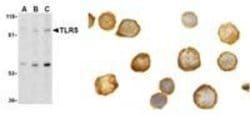
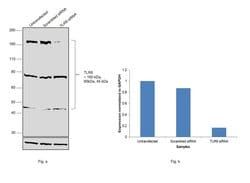
Immunocytochemistry, Western Blot
Conjugate
Unconjugated
Gene
TLR7
Gene Symbols
TLR7
Immunogen
Synthetic peptide corresponding to 14 residues near the middle of mouse TLR7.
Quantity
100 μg
Primary or Secondary
Primary
Target Species
Human, Mouse
Product Type
Antibody
Isotype
IgG
Related Products


Description
- A suggested positive control for this product is Daudi cell lysate
- TLR7 is a 1049 amino acid long highly conserved membrane protein belonging to the Toll-like receptor (TLR) family with 27 LRR (leucine-rich) repeats and a TIR domain
- TLR7 plays a fundamental role in pathogen recognition and activation of innate immunity
- TLR7 is activated by infections with single-stranded RNA viruses, including influenza virus and vesicular stomatitis virus (VSV)
- TLR7 is predomitly expressed in lung, placenta, and spleen, and lies in close proximity to another family member, TLR8
- TLR7 also acts via MyD88 and TRAF6, leading to NF-kappaB activation, cytokine secretion and the inflammatory response
- TLR7 recognize pathogen-associated molecular patterns (PAMPs) that are expressed on infectious agents, and mediate the production of cytokines necessary for the development of effective immunity.