Cystatin C Polyclonal Antibody, Invitrogen™
Rabbit Polyclonal Antibody
Manufacturer: Fischer Scientific
The price for this product is unavailable. Please request a quote
Antigen
Cystatin C
Applications
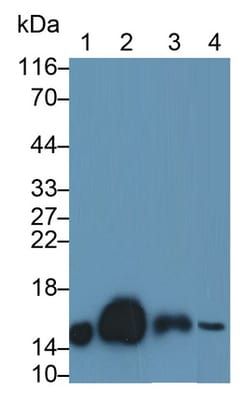
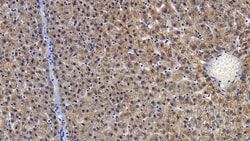
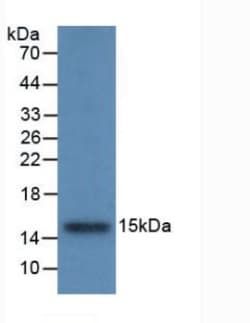
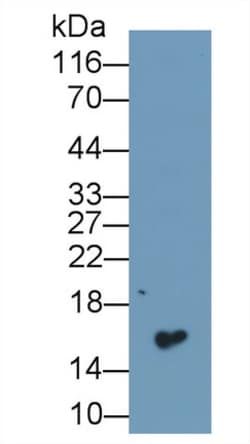
Immunocytochemistry, Immunohistochemistry (Paraffin), Western Blot
Conjugate
Unconjugated
Host Species
Rabbit
Target Species
Chicken, Human
Gene Accession No.
P01034, P01038
Gene ID (Entrez)
1471, 396497
Immunogen
Recombinant Chicken Cys-C protein, Ser24-Gln139 (Accession #P01038)
Primary or Secondary
Primary
Content And Storage
Store at 4°C short term. For long term storage, store at -20°C, avoiding freeze/thaw cycles.
Concentration
0.5 mg/mL
Classification
Polyclonal
Form
Liquid
Regulatory Status
RUO
Formulation
PBS with 50% glycerol and 0.05% Proclin 300, pH 7.4
Gene Alias
AD8, ARMD11, bA218C14.4 (cystatin C), CST3, CYSC, cystatin, cystatin 3, cystatin C, cystatin C (amyloid angiopathy and cerebral hemorrhage), Cystatin C (cysteine proteinase inhibitor), Cystatin3, cystatin-3, CystatinC, Cystatin-C, epididymis secretory protein Li 2, fb51d07, Gamma-trace, HEL-S-2, MGC117328, neuroendocrine basic polypeptide, OTTHUMP00000030440, OTTHUMP00000164181, OTTHUMP00000164182, OTTMUSP00000016736, Post-gamma-globulin, RP23-250M11.9, wu:fb24g06, wu:fb51d07, wu:fc55f03, zgc:136227
Gene Symbols
Cst3
Isotype
IgG
Purification Method
Protein A
Gene
Cst3
Related Products
Description
- Cystatin C, a member of the type 2 cystatin superfamily, is a potent inhibitor of cysteine proteinases, both endogenous (lysosomal cathepsins), and pathogenic
- Cystatin C is a 13 kDa secreted protein which is found in high concentrations in biological fluids and is thought to be expressed by all human nucleated cells
- Changes in Cystatin C have been documented in a number of cardiovascular diseases, including atherosclerosis, amyloid angiopathy and myocardial infarction
- Its low molecular weight also means that Cystatin C can be used as a marker of renal failure.