JAK3 Polyclonal Antibody, Invitrogen™
Rabbit Polyclonal Antibody
Manufacturer: Fischer Scientific
The price for this product is unavailable. Please request a quote
Antigen
JAK3
Applications
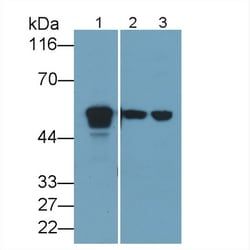
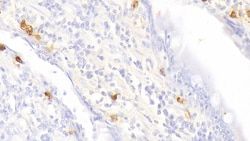
Immunocytochemistry, Immunohistochemistry (Paraffin), Western Blot
Conjugate
Unconjugated
Host Species
Rabbit
Target Species
Mouse, Rat
Gene Accession No.
Q62137, Q63272
Gene ID (Entrez)
16453, 25326
Immunogen
Recombinant Mouse JAK3 protein, Leu517-Ala749 (Accession #Q62137)
Primary or Secondary
Primary
Content And Storage
Store at 4°C short term. For long term storage, store at -20°C, avoiding freeze/thaw cycles.
Concentration
0.5 mg/mL
Classification
Polyclonal
Form
Liquid
Regulatory Status
RUO
Formulation
PBS with 50% glycerol and 0.05% Proclin 300, pH 7.4
Gene Alias
Breast-JAK3, fae, JAK3, JAK-3, JAK3_HUMAN, JAK3B, JAKL, Janus kinase 3, Janus kinase 3 (a protein tyrosine kinase, leukocyte), Janus kinase 3 protein-tyrosine kinase, Janus kinase 3, protein-tyrosine kinase, L JAK, Leukocyte janus kinase, LJAK, L-JAK, RATJAK3, Tyrosine-protein kinase JAK3, wil
Gene Symbols
JAK3
Isotype
IgG
Purification Method
Protein A
Gene
JAK3
Related Products
Description
- Janus kinase 3 (JAK3) phosphorylates members of the STAT (signal transduction and activators of transcription) family
- JAK3 is predominantly expressed in immune cells and transduces a signal in response to activation of interleukin receptors
- In response to a varitety of cytokine or related factors (e.g., interferon, interleukins), JAKs are activated via phosphorylation at 2 adjacent tyrosine residues
- The activation of JAKs can lead to the phosphorylation of STAT (signal transducers and activatiors of transcription) proteins, which dimerize and translocate to the nucleus
- Once translocated to the nucleus, the STAT proteins can modify transcription of numerous genes, including interferon-stimulated genes
- JAK2 is required for the IFN gamma-receptor complex initiation and JAK1 functions as an amplifier
- However, active JAK1 may be required for complex responses
- Some studies have suggested that the role of JAK2 might be performed by Tyk2 and JAK3, if they were positioned correctly within the IFN gamma-receptor complex.