4325880
CD247 with control Mouse anti-Human, Unlabeled, Clone: 8D3, BD
Mouse Monoclonal Antibody
Manufacturer: Fischer Scientific
The price for this product is unavailable. Please request a quote
Antigen
CD247 with control
Applications
Western Blot
Conjugate
Unconjugated
Regulatory Status
RUO
Isotype
IgG1
Purification Method
Affinity Purified
Description
CD3ζ chain
Clone
8D3
Classification
Monoclonal
Host Species
Mouse
Target Species
Human, Mouse
Primary or Secondary
Primary
Content And Storage
Store undiluted at -20°C.
Related Products


Description
- The T-cell receptor (TCR), expressed by thymus-derived lymphocytes, is a multi-component complex responsible for recognizing antigen in the context of MHC molecules
- Ti is the antigen-specific binding component of the TCR
- On the majority of peripheral T lymphocytes Ti is present as a disulfide-linked α - β heterodimer
- A minor fraction express Ti as a γ- δ heterodimer
- The Ti subunits are Ig-like, each containing V and C regions
- Ti is noncovalently associated with an invariant set of molecules referred to as the CD3 subunits
- CD3 appears early in thymocyte differentiation and remains expressed on all mature T lymphocytes
- In the mouse, it consists of five chains, γ(gamma), δ (delta), ε (epsilon), ζ (zeta), and p21
- The relative masses of the mouse CD3 chains are 21, 28, 26, 32 (dimer), and 21 kDa respectively
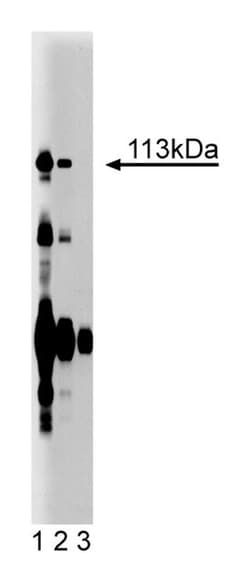
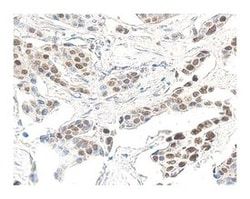
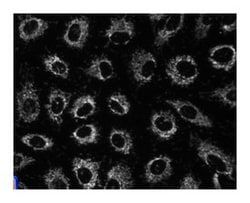
- The 8D3 antibody recognizes the ζ chain of the human and mouse T cell antigen receptor-associated CD3 complex
- It reacts with 16 kDa unphosphorylated monomers and 32 kDa unphosphorylated dimers
- It does not appear to recognize 21 kDa phosphorylated monomers or 42 kDa phosphorylated dimers
- A synthetic peptide corresponding to a region of human CD3 ζ was used as immunogen.