Sall1 Monoclonal Antibody (NRNSTNX), eFluor™ 450, eBioscience™, Invitrogen™
Manufacturer: Invitrogen
Select a Size
| Pack Size | SKU | Availability | Price |
|---|---|---|---|
| Each of 1 | 48-972-982-Each-of-1 | In Stock | ₹ 40,940.00 |
48-972-982 - Each of 1
In Stock
Quantity
1
Base Price: ₹ 40,940.00
GST (18%): ₹ 7,369.20
Total Price: ₹ 48,309.20
Antigen
Sall1
Classification
Monoclonal
Concentration
0.2 mg/mL
Formulation
PBS with 0.09% sodium azide; pH 7.2
Gene Accession No.
Q9ER74
Gene Symbols
SALL1
Immunogen
C-terminal fragment of the protein (aa-805-1322)
Quantity
100 μg
Primary or Secondary
Primary
Target Species
Mouse
Product Type
Antibody
Isotype
IgG2a κ
Applications
Flow Cytometry
Clone
NRNSTNX
Conjugate
eFluor 450
Gene
SALL1
Gene Alias
epididymis secretory protein Li 89; HEL-S-89; HSal1; Msal-3; SAL1; Sal-1; sal-3; SALL1; sal-like 1; sal-like 1 (Drosophila); sal-like protein 1; spalt like transcription factor 1; spalt-like transcription factor 1; TBS; Zinc finger protein 794; zinc finger protein SALL1; Zinc finger protein Spalt-1; zinc finger protein Spalt-3; ZNF794
Host Species
Rat
Purification Method
Affinity chromatography
Regulatory Status
RUO
Gene ID (Entrez)
58198
Content And Storage
4° C, store in dark, DO NOT FREEZE!
Form
Liquid
Related Products


Description
- Description: This NRNSTNX monoclonal antibody recognizes mouse Sall1
- Applications Reported: This NRNSTNX antibody has been reported for use in intracellular staining followed by flow cytometric analysis
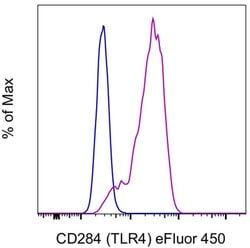
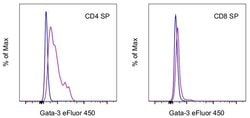
- Applications Tested: This NRNSTNX antibody has been tested by intracellular staining followed by flow cytometric analysis of mouse brain cells using the Intracellular Fixation & Permeabilization Buffer Set (Product # 88-8824-00) and protocol
- Please refer to Staining Intracellular Antigens for Flow Cytometry, Protocol A: Two step protocol for intracellular (cytoplasmic) proteins located at www.thermofisher.com/flowprotocols
- This may be used at less than or equal to 1.0 μg per test
- A test is defined as the amount (μg) of antibody that will stain a cell sample in a final volume of 100 μL
- Cell number should be determined empirically but can range from 10^5 to 10^8 cells/test
- It is recommended that the antibody be carefully titrated for optimal performance in the assay of interest
- eFluor 450 is an alternative to Pacific Blue
- eFluor 450 emits at 446 nm and is excited with the violet laser line (405 nm)
- Please make sure that your instrument is capable of detecting this fluorochrome
- Excitation: 405 nm; Emission: 445 nm; Laser: Violet Laser Sall1, which encodes a zinc finger protein, functions as a transcriptional repressor and interacts physically with histone deacetylase and other components of the chromatin remodeling NuRD complex
- It is unknown whether the transcriptional repression is solely dependent on histone deacetylase activity
- Gene expression profiling has identified Sall1 as a microglial signature gene
- Microglia are the resident macrophages of the central nervous system (CNS)
- Sall1 is also expressed in abundance in the mesenchyme-derived structure from condensed mesenchyme, S-comma-shaped bodies, to renal tubules and podocytes
- Sall1 has been identified as a key transcription factor in self-renewal renal progenitor cells
- Sall1 is required to maintain the stemness of nephron progenitor cells by restraining their differentiation into renal vesicles
- Defects in SALL1 are the cause of Townes-Brocks syndrome as well as bronchio-oto-renal syndrome
- Heterozygous mutations of human SALL1 leading to Townes–Brocks syndrome features dysplastic ears, preaxial polydactyly, imperforate anus, and less commonly, kidney and heart anomalies (Kohlhase et al
- 1998)
- Two transcript variants encoding different isoforms have been found for this gene.