CCL3 (MIP-1 alpha) Monoclonal Antibody (CR3M), PE, eBioscience™, Invitrogen™
Manufacturer: Invitrogen
Select a Size
| Pack Size | SKU | Availability | Price |
|---|---|---|---|
| Each of 1 | 50-112-2448-Each-of-1 | In Stock | ₹ 30,349.00 |
50-112-2448 - Each of 1
In Stock
Quantity
1
Base Price: ₹ 30,349.00
GST (18%): ₹ 5,462.82
Total Price: ₹ 35,811.82
Antigen
CCL3 (MIP-1 alpha)
Classification
Monoclonal
Concentration
5 μL/Test
Formulation
PBS with 0.2% BSA and 0.09% sodium azide; pH 7.2
Gene Accession No.
P10147
Gene Symbols
Ccl3
Purification Method
Affinity chromatography
Regulatory Status
RUO
Gene ID (Entrez)
6348
Content And Storage
4° C, store in dark, DO NOT FREEZE!
Form
Liquid
Applications
Flow Cytometry
Clone
CR3M
Conjugate
PE
Gene
Ccl3
Gene Alias
AI323804; C-C motif chemokine 3; C-C motif chemokine ligand 3; CCL3; chemokine (C-C motif) ligand 3; G0/G1 switch regulatory protein 19-1; G0S19-1; Heparin-binding chemotaxis protein; H-MIP-1-alpha; L2G25B; LD78ALPHA; LD78-alpha; LD78-alpha(4-69); Macrophage inflammatory protein 1 alpha (Small inducible cytokine A3); macrophage inflammatory protein 1-alpha; macrophage inflammatory protein-1alpha; MIP1 (a); mip1 alpha; MIP-1 alpha; MIP1-(a); MIP1A; MIP-1a; MIP-1alpha; MIP-1-alpha; MIP1-alpha; MIP-1-alpha(4-69); PAT 464.1; RP23-320E6.7; Scya3; SIS-alpha; SIS-beta; small inducible cytokine A3; small inducible cytokine A3 (homologous to mouse Mip-1a); small-inducible cytokine A3; Tonsillar lymphocyte LD78 alpha protein; TY-5
Host Species
Mouse
Quantity
100 Tests
Primary or Secondary
Primary
Target Species
Human
Product Type
Antibody
Isotype
IgG1 κ
Related Products

Description
- Description: This CR3M monoclonal antibody reacts with human CCL3
- CCL3, also known as MIP-1 alpha (Macrophage Inflammatory Protein 1 alpha), is a member of the CC- subfamily of chemokines and is most closely related to CCL4, or MIP-1 beta
- These proteins play critical roles in the recruitment of leukocytes to the site of inflammation
- While both CCL3 and CCL4 will attract monocytes, macrophages, and dendritic cells, CCL3 preferentially attracts CD8+ T cells, while CD4+ T cells are more responsive to CCL4
- In addition to its chemotactic functions, CCL3 induces inflammatory cytokine secretion, mast cell degranulation, and NK cell activation
- It has also been reported to inhibit hematopoetic stem cell proliferation and may be responsible for the maintece of these cells in a quiescent state.∣CCL3 signaling is mediated by the G protein-coupled receptors CCR1, CCR4, and CCR5, which are shared with CCL4 and CCL5 (RANTES)
- CCR5 is the primary co-receptor for HIV entry, which the virus binds through the gp120 envelope protein
- All CCR5 ligands demonstrate potent inhibition of virus entry into the cell, both through steric hindrance of gp120-CCR5 interaction, and ligand-mediated receptor internalization
- This CR3M clone is specific to CCL3, with no detectable cross-reactivity to Human CCL4 (MIP-1 beta)
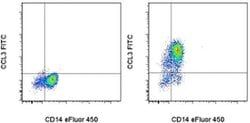
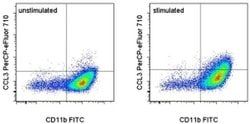
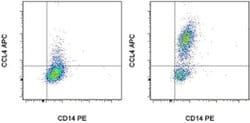
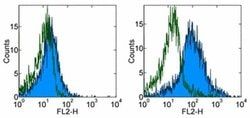
- Applications Reported: This CR3M antibody has been reported for use in intracellular staining followed by flow cytometric analysis
- Both MIP-1alpha and MIP-1beta are structurally and functionally related CC chemokines
- They participate in host response to invading bacterial, viral, parasite and fungal pathogens by regulating the trafficking and activation state of selected subgroups of inflammatory cells (e.g
- macrophages, lymphocytes and NK cells)
- While both MIP-1alpha and MIP-1beta exert similar effects on monocytes, their effect on lymphocytes differ; with MIP-1alpha selectively attracting CD8+ lymphocytes, and MIP-1beta selectively attracting CD4+ lymphocytes
- Additionally, MIP-1alpha and MIP-1beta have also been shown to be potent chemoattractants for B cells, eosinophils and dendritic cells
- Both human and murine MIP-1alpha and MIP-1beta are active on human and murine hematopoietic cells.