50-151-20
CD199 (CCR9) Monoclonal Antibody (eBioCW-1.2 (CW-1.2)), APC, eBioscience™, Invitrogen™
Manufacturer: Fischer Scientific
Select a Size
| Pack Size | SKU | Availability | Price |
|---|---|---|---|
| Each of 1 | 50-151-20-Each-of-1 | In Stock | ₹ 15,753.00 |
50-151-20 - Each of 1
In Stock
Quantity
1
Base Price: ₹ 15,753.00
GST (18%): ₹ 2,835.54
Total Price: ₹ 18,588.54
Antigen
CD199 (CCR9)
Classification
Monoclonal
Concentration
0.2 mg/mL
Formulation
PBS with 0.09% sodium azide; pH 7.2
Gene Accession No.
Q9WUT7
Gene Symbols
Ccr9
Purification Method
Affinity chromatography
Regulatory Status
RUO
Gene ID (Entrez)
12769
Content And Storage
4° C, store in dark, DO NOT FREEZE!
Form
Liquid
Applications
Flow Cytometry
Clone
eBioCW-1.2 (CW-1.2)
Conjugate
APC
Gene
Ccr9
Gene Alias
A130091K22Rik; C-C chemokine receptor type 9; C-C CKR-9; C-C motif chemokine receptor 9; CC-CKR-9; Ccr9; CCR-9; CDw199; CDw199 antigen; chemokine (C-C motif) receptor 9; chemokine C-C receptor 10; Cmkbr10; G protein-coupled receptor 28; GPR28; GPR-9-6; G-protein coupled receptor 28
Host Species
Mouse
Quantity
25 μg
Primary or Secondary
Primary
Target Species
Mouse
Product Type
Antibody
Isotype
IgG2a
Related Products
Description
- Description: The eBioCW-1.2 monoclonal antibody reacts with mouse CCR9 (CD199), which is the receptor for thymus-expressed chemokine (TECK)
- CCR9 is a member of the G protein coupled receptor (GPCR) supergene family, and is involved in trafficking of T cell progenitors within the thymus
- CCR9 expression during thymocyte development commences at the double-negative (DN) 3 stage (CD4-CD8-CD25+CD44-), peaks in the double-positive (DP) stage (CD4+CD8+CD25-CD44-), and is down-regulated in commited CD4+ or CD8+ single-positive (SP) thymoyctes
- CCR9-deficient mice show a mild impairment in thymoycte development
- In the periphery, CCR9 is thought to be expressed on naive CD8+ T cells, but not on naive CD4+ T cells
- Applications Reported: This eBioCW-1.2 (CW-1.2) antibody has been reported for use in flow cytometric analysis
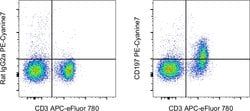
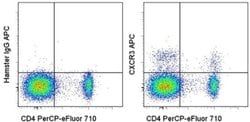
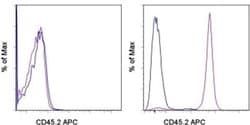
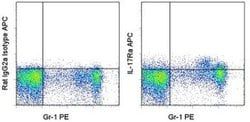
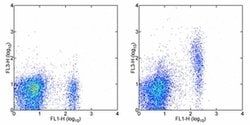
- Applications Tested: This eBioCW-1.2 (CW-1.2) antibody has been tested by flow cytometric analysis of mouse thymocytes
- This can be used at less than or equal to 0.25 μg per million cells in a 100 μL total staining volume
- It is recommended that the antibody be carefully titrated for optimal performance in the assay of interest
- Excitation: 633-647 nm; Emission: 660 nm; Laser: Red Laser
- Filtration: 0.2 μm post-manufacturing filtered
- The protein encoded by this gene is a member of the beta chemokine receptor family
- It is predicted to be a seven transmembrane protein similar to G protein-coupled receptors
- Chemokines and their receptors are key regulators of the thymocytes migration and maturation in normal and inflammation conditions
- The specific ligand of this receptor is CCL25
- It has been found that this gene is differentially expressed by T lymphocytes of small intestine and colon, suggested a role in the thymocytes recruitment and development that may permit functional specialization of immune responses in different segment of the gastrointestinal tract
- This gene is mapped to the chemokine receptor gene cluster region
- Two alternatively spliced transcript variants have been described.