50-155-6965
Sp1 Polyclonal Antibody, Bethyl Laboratories
Manufacturer: Bethyl Laboratories, Inc
Select a Size
| Pack Size | SKU | Availability | Price |
|---|---|---|---|
| Each of 1 | 50-155-6965-Each-of-1 | In Stock | ₹ 12,384.35 |
50-155-6965 - Each of 1
In Stock
Quantity
1
Base Price: ₹ 12,384.35
GST (18%): ₹ 2,229.183
Total Price: ₹ 14,613.533
Antigen
Sp1
Classification
Polyclonal
Formulation
TBS with 0.1% BSA and 0.09% sodium azide
Gene Accession No.
O89090, P08047
Gene Symbols
Sp1
Immunogen
Between 750 and C-term
Quantity
20 μL
Primary or Secondary
Primary
Target Species
Human, Mouse
Product Type
Antibody
Isotype
IgG
Applications
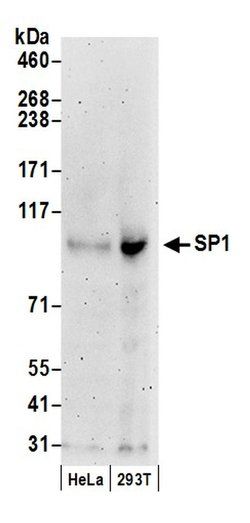
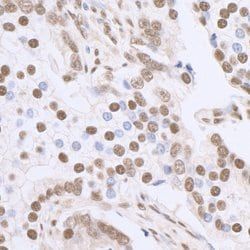
Immunohistochemistry, Western Blot
Conjugate
Unconjugated
Gene
SP1
Gene Alias
SP1; Sp1 transcription factor ; HGNC:11205
Host Species
Rabbit
Purification Method
Antigen affinity chromatography
Regulatory Status
RUO
Gene ID (Entrez)
20683, 6667
Content And Storage
4° C
Form
Liquid
Related Products


Description
- The recommended shelf life for this product is 1 year from date of receipt
- Application Note: For IHC, epitope retrieval with citrate buffer pH 6.0 is recommended for FFPE tissue sections
- Transcription factor that can activate or repress transcription in response to physiological and pathological stimuli
- Binds with high affinity to GC-rich motifs and regulates the expression of a large number of genes involved in a variety of processes such as cell growth, apoptosis, differentiation and immune responses
- Highly regulated by post-translational modifications (phosphorylations, sumoylation, proteolytic cleavage, glycosylation and acetylation)
- Binds also the PDGFR-alpha G-box promoter
- May have a role in modulating the cellular response to DNA damage
- Implicated in chromatin remodeling
- Plays a role in the recruitment of SMARCA4/BRG1 on the c-FOS promoter
- Plays an essential role in the regulation of FE65 gene expression.