50-167-4760
USP7 Mouse anti-Human, Clone: OTI1F12, liquid, TrueMAB™
Manufacturer: OriGene
Select a Size
| Pack Size | SKU | Availability | Price |
|---|---|---|---|
| Each of 1 | 50-167-4760-Each-of-1 | In Stock | ₹ 44,954.79 |
50-167-4760 - Each of 1
In Stock
Quantity
1
Base Price: ₹ 44,954.79
GST (18%): ₹ 8,091.862
Total Price: ₹ 53,046.652
Antigen
USP7
Classification
Monoclonal
Concentration
0.8 mg/mL
Formulation
PBS with 1% BSA, 50% glycerol and 0.02% sodium azide
Gene Accession No.
Q93009
Gene Symbols
USP7
Immunogen
Full length human recombit protein of human USP7 produced in HEK293T cell.
Quantity
100 μL
Primary or Secondary
Primary
Target Species
Human
Product Type
Antibody
Isotype
IgG1
Applications
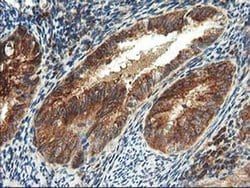
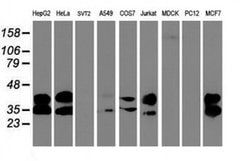
Flow Cytometry, Immunohistochemistry (Paraffin), Western Blot
Clone
OTI1F12
Conjugate
Unconjugated
Gene
USP7
Gene Alias
HAUSP, TEF1
Host Species
Mouse
Purification Method
Affinity Chromatography
Regulatory Status
RUO
Gene ID (Entrez)
7874
Content And Storage
-20° C, Avoid Freeze/Thaw Cycles
Form
Liquid
Related Products





Description
- USP7 or HAUSP is a ubiquitin specific protease or a deubiquitylating enzyme that cleaves ubiquitin from its substrates
- Since ubiquitylation (polyubiquitination) is most commonly associated with the stability and degradation of cellular proteins, HAUSP acitivity generally stabilizes its substrate proteins
- HAUSP is most popularly known as a direct antagonist of Mdm2, the E3 ubiquitin ligase for the tumor suppressor protein, p53.Normally, p53 levels are kept low in part due to Mdm2-mediated ubiquitylation and degradation of p53
- Interestingly, in response to oncogenic insults, HAUSP can deubiquitinate p53 and protect p53 from Mdm2-mediated degradation, indicating that it may possess a tumor suppressor function for the immediate stabilization of p53 in response to stress
- Another important role of HAUSP function involves the oncogenic stabilization of p53
- Oncogenes such as Myc and E1A are thought to activate p53 through a p19 alternative reading frame (p19ARF, also called ARF)-dependent pathway, although some evidence suggests ARF is not essential in this process
- An intriguing possibility is that HAUSP provides an alternative pathway for safeguarding the cell against oncogenic insults.