CCL5 (RANTES) Monoclonal Antibody (VL1), eFluor™ 660, eBioscience™, Invitrogen™
Manufacturer: Invitrogen
Select a Size
| Pack Size | SKU | Availability | Price |
|---|---|---|---|
| Each of 1 | 50-990-542-Each-of-1 | In Stock | ₹ 29,192.00 |
50-990-542 - Each of 1
In Stock
Quantity
1
Base Price: ₹ 29,192.00
GST (18%): ₹ 5,254.56
Total Price: ₹ 34,446.56
Antigen
CCL5 (RANTES)
Classification
Monoclonal
Concentration
5 μL/Test
Formulation
PBS with 0.2% BSA and 0.09% sodium azide; pH 7.2
Gene Accession No.
P13501
Gene Symbols
CCL5
Purification Method
Affinity chromatography
Regulatory Status
RUO
Gene ID (Entrez)
6352
Content And Storage
4° C, store in dark, DO NOT FREEZE!
Form
Liquid
Applications
Flow Cytometry
Clone
VL1
Conjugate
eFluor 660
Gene
CCL5
Gene Alias
beta-chemokine RANTES; CC chemokine; C-C motif chemokine 5; C-C motif chemokine ligand 5; CCL5; chemokine (C-C motif) ligand 5; D17S136E; EoCP; eosinophil chemotactic cytokine; MGC17164; MuRantes; OTTHUMP00000197106; RANTES; RANTES protein; RANTES(3-68); RANTES(4-68); regulated upon activation normal T-cell expressed and secreted; regulated upon activation, normally T-expressed, and presumably secreted; Scya5; SIS d; SISd; SIS-delta; SISd; small inducible cytokine A5; small inducible cytokine subfamily A (Cys-Cys), member 5; small-inducible cytokine A5; T cell-specific protein P228; T-cell specific protein p288; T-cell-specific protein RANTES; TCP228; Unknown (protein for MGC:127014)
Host Species
Mouse
Quantity
100 Tests
Primary or Secondary
Primary
Target Species
Human
Product Type
Antibody
Isotype
IgG2b κ
Related Products



Description
- Description: The VL1 monoclonal antibody reacts with human CCL5/RANTES (Regulated upon Activation, Normal T cell Expressed and Secreted)
- RANTES is an 8 kDa member of the C-C chemokine family
- Although rapidly induced in fibroblasts and epithelial cells, RANTES is upregulated only after 3-5 days of activation in T cells
- As with other members of the C-C chemokine family, RANTES is a strong chemotractant for monocytes, NK cells, eosinophils and T cells
- RANTES is also expressed by monocytes upon activation and has recently been reported to be constitutively expressed by NK cells
- Applications Reported: This VL1 antibody has been reported for use in intracellular staining followed by flow cytometric analysis
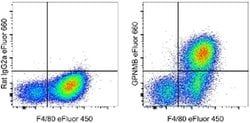
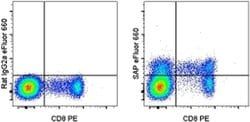
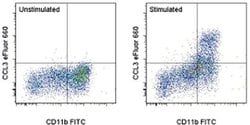
- Applications Tested: This VL1 antibody has been pre-titrated and tested by intracellular staining and flow cytometric analysis of stimulated normal human peripheral blood cells
- This can be used at 5 μL (0.25 μg) per test
- A test is defined as the amount (μg) of antibody that will stain a cell sample in a final volume of 100 μL
- Cell number should be determined empirically but can range from 10^5 to 10^8 cells/test
- eFluor™ 660 is a replacement for Alexa Fluor™ 647
- eFluor™ 660 emits at 659 nm and is excited with the red laser (633 nm)
- Please make sure that your instrument is capable of detecting this fluorochome
- Excitation: 633-647 nm; Emission: 668 nm; Laser: Red Laser
- Filtration: 0.2 μm post-manufacturing filtered
- CCL5 (RANTES) is a chemokine gene located on the q-arm of chromosome 17
- Chemokines are a superfamily of secreted proteins involved in immunoregulatory and inflammatory processes
- The superfamily is divided into four subfamilies based on the arrangement of the N-terminal cysteine residues of the mature peptide
- CCL5, a member of the CC subfamily, functions as a chemoattractant for blood monocytes, memory T helper cells, and eosinophils
- It causes the release of histamine from basophils and activates eosinophils
- This cytokine is one of the major HIV-suppressive factors produced by CD8+ cells
- It functions as one of the natural ligands for the chemokine receptor chemokine (C-C motif) receptor 5 (CCR5), and it suppresses in vitro replication of the R5 strains of HIV-1, which use CCR5 as a coreceptor
- Alternative splicing results in multiple transcript variants that encode different isoforms
- Diseases associated with CCL5 include Human Immunodeficiency Virus Type 1 and Periapical Granuloma.