CD209b (SIGN-R1) Monoclonal Antibody (eBio22D1 (22D1)), Alexa Fluor™ 488, eBioscience™, Invitrogen™
Manufacturer: Invitrogen
Select a Size
| Pack Size | SKU | Availability | Price |
|---|---|---|---|
| Each of 1 | 53-209-382-Each-of-1 | In Stock | ₹ 35,600.00 |
53-209-382 - Each of 1
In Stock
Quantity
1
Base Price: ₹ 35,600.00
GST (18%): ₹ 6,408.00
Total Price: ₹ 42,008.00
Antigen
CD209b (SIGN-R1)
Classification
Monoclonal
Concentration
0.5 mg/mL
Formulation
PBS with 0.09% sodium azide; pH 7.2
Gene Accession No.
Q8CJ91, Q91ZX1
Gene Symbols
Cd209a, Cd209b
Purification Method
Affinity chromatography
Regulatory Status
RUO
Gene ID (Entrez)
170786, 69165
Content And Storage
4° C, store in dark, DO NOT FREEZE!
Form
Liquid
Applications
Flow Cytometry
Clone
eBio22D1 (22D1)
Conjugate
Alexa Fluor 488
Gene
Cd209b
Gene Alias
1810030I22Rik; CD209; CD209 antigen-like protein A; CD209 antigen-like protein B; Cd209a; CD209a antigen; CD209a molecule; Cd209b; CD209b antigen; CDSIGN; CIRE; DC SIGNR1; Dcsign; DC-SIGN; DC-SIGN1; DC-SIGNR1; DC-SIGN-related protein 1; Dendritic cell-specific ICAM-3-grabbing non-integrin; MGC130443; mSIGNR1; OtB7; SIGNR1; SIGN-R1; SIGNR5
Host Species
Armenian Hamster
Quantity
100 μg
Primary or Secondary
Primary
Target Species
Mouse
Product Type
Antibody
Isotype
IgG
Related Products




Description
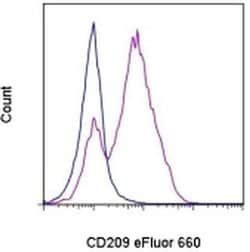
- Armenian Hamster Monoclonal Antibody SIGNR1 is a type II transmembrane C-type lectin that was identified in a search for mouse homologues of human DC-SIGN
- It is expressed at high levels in splenic marginal zone macrophages and lymph node medullary macrophages, where it functions to uptake dextran polysaccharides, including the capsular polysaccharide of Streptococcus pneumoniae
- It has also been demonstrated that SIGNR1 physically associates with TLR4/MD2, and it has been suggested that this association plays a role in recognition of LPS
- Furthermore, recently it has been shown that SIGNR1 deficient mice have a defect in catabolism of the complement component C3, and that SIGNR1 binds directly to the complement C1 subcomponent, C1q to assemble a non-conventional C3 convertase.