ISG15 Recombinant Rabbit Monoclonal Antibody (7H29L24), Invitrogen™
Manufacturer: Invitrogen
Select a Size
| Pack Size | SKU | Availability | Price |
|---|---|---|---|
| Each of 1 | 70-313-1-Each-of-1 | In Stock | ₹ 44,500.00 |
70-313-1 - Each of 1
In Stock
Quantity
1
Base Price: ₹ 44,500.00
GST (18%): ₹ 8,010.00
Total Price: ₹ 52,510.00
Antigen
ISG15
Classification
Monoclonal
Concentration
0.5 mg/mL
Formulation
PBS with 0.09% sodium azide; pH 7.4
Gene Accession No.
P05161
Gene Symbols
ISG15
Immunogen
Protein corresponding to human ISG15 [aa2-aa155]
Quantity
100 μg
Primary or Secondary
Primary
Target Species
Human
Product Type
Antibody
Isotype
IgG
Applications
Western Blot
Clone
7H29L24
Conjugate
Unconjugated
Gene
ISG15
Gene Alias
G1P2; hUCRP; IFI15; IGI15; IMD38; interferon, alpha-inducible protein; interferon, alpha-inducible protein (clone IFI-15K); interferon-induced 15 kDa protein; interferon-induced 15-KDa protein; interferon-induced 17 kDa protein; interferon-induced 17-kDa/15-kDa protein; interferon-stimulated protein (15 kDa); interferon-stimulated protein 15; interferon-stimulated protein, 15 kDa; IP17; Irfp; Isg15; ISG15 ubiquitin like modifier; ISG15 ubiquitin-like modifier; ubiquitin cross-reactive protein; Ubiquitin-like protein ISG15; UCRP
Host Species
Rabbit
Purification Method
Protein A
Regulatory Status
RUO
Gene ID (Entrez)
9636
Content And Storage
Store at 4°C short term. For long term storage, store at -20°C, avoiding freeze/thaw cycles.
Form
Liquid
Related Products
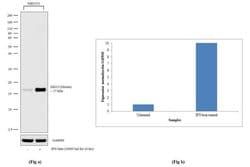




Description
- This antibody is predicted to react with Monkey, Dog, Cat, Pig
- Recombinant rabbit monoclonal antibodies are produced using in vitro expression systems
- The expression systems are developed by cloning in the specific antibody DNA sequences from immunoreactive rabbits
- Then, individual clones are screened to select the best candidates for production
- The advantages of using recombinant rabbit monoclonal antibodies include: better specificity and sensitivity, lot-to-lot consistency, animal origin-free formulations, and broader immunoreactivity to diverse targets due to larger rabbit immune repertoire
- Ubiquitin-like protein ISG15 plays a key role in the innate immune response to viral infection either via its conjugation to a target protein (ISGylation) or via its action as a free or unconjugated protein
- It is secreted from monocytes in response to type I interferons and causes natural killer (NK)-cell proliferation and an augmentation of non-MCH (major histocompatibility complex)-restricted cytotoxicity
- Synthesis is stimulated by IFN-alpha or IFN-beta or IFN-omega, but not IFN-gamma
- ISG15 expression is also induced by overexpression of interferon regulatory factors that participate in transcriptional regulation of IFN genes, and by influenza B virus
- ISG15 is secreted by cell lines of monocyte, T-lymphocyte, B-lymphocyte, human fibroblasts, and epithelial origins
- Enhancement of NK cell proliferation, augmentation of non-major histocompatibility complex-restricted cytotoxicity, and induction of IFN-gamma from T cells identify ISG15 as a member of the cytokine cascade and suggest that it may be responsible for amplifying and directing some of the immunomodulatory effects of IFN-alpha or IFN-beta
- ISG15 has has also been shown to function intracellularly as a ubiquitin homolog
- Mutations affecting the gene can result in Immunodeficiency 38, with basal ganglia calcification (IMD38).