7068461
Perforin Monoclonal Antibody (eBioOMAK-D), FITC, eBioscience™, Invitrogen™
Rat Monoclonal Antibody
Manufacturer: Fischer Scientific
The price for this product is unavailable. Please request a quote
Antigen
Perforin
Concentration
0.5 mg/mL
Classification
Monoclonal
Form
Liquid
Regulatory Status
RUO
Formulation
PBS with 0.09% sodium azide; pH 7.2
Gene Alias
Cyta; Cytolysin; FLH2; HPLH2; lymphocyte pore forming protein; lymphocyte pore-forming protein; OMAK; OTTHUMP00000019759; P1; perforin 1; perforin 1 (pore forming protein); Perforin1; perforin-1; Pfn; PFN1; Pfp; PGFL; PIGF; PIGF-2; PLGF; pore forming protein; pore-forming protein; PRF1; Prf-1; PRF1 (pore forming protein 1); RATCYTA; RP11-710A11.3
Gene Symbols
PRF1
Primary or Secondary
Primary
Content And Storage
4° C, store in dark, DO NOT FREEZE!
Gene
PRF1
Clone
eBioOMAK-D
Applications
Flow Cytometry
Conjugate
FITC
Host Species
Rat
Target Species
Mouse
Gene Accession No.
P10820
Gene ID (Entrez)
18646
Isotype
IgG2a κ
Purification Method
Affinity chromatography
Product Type
Antibody
Related Products




Description
- Description: The eBioOMAK-D antibody reacts with mouse perforin (pore-forming protein, pfp, Prf)
- Perforin is one of the cytolytic mediators present in the cytoplasmic granules of cytotoxic T lymphocytes (CTL) and natural killer cells (NK)
- Perforin is involved in the killing function by CTLs and NKs and has an important role in the immune response against tumors and virus infections
- By immunobloting, eBioOMAK-D recognizes a ∽70kDa band in lysates of CTLL-2 mouse cytotoxic cell line and in lysates of IL-2 stimulated but not unstimulated mouse splenocytes
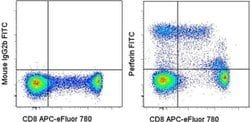
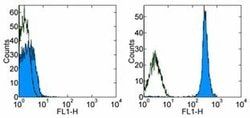
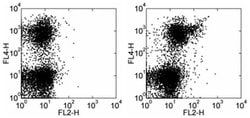
- By multi-color intracellular flow cytometric analysis, eBioOMAK-D staining is increased upon stimulation (IL-2 or anti-CD3/28)
- Intracellular flow staining results showing upregulation of protein expression have been confirmed by immunoblotting
- Furthermore, stimulated Perforin Knock-out (developed by Walsh) splenocytes do not stain with eBioOMAK-D nor is any protein detectable by western blotting with eBioOMAK-D as well as other anti-mouse perforin antibodies
- Please note that the Kagi perforin knock-out mice may synthesize a truncated form of the protein which may be recognized by eBioOMAK-D
- In IL-2 stimulated mouse splenocytes, NK cells (as determined by CD49b staining) contain perforin while CD8 cells contain little to none and can vary with culture conditions
- This has been confirmed by staining and western blotting the two populations using both OMAK-D and P1-8 antibodies
- Perforin is one of the major cytolytic proteins of cytolytic granules
- Perforin is a cytolytic mediator and is stored in and released by cytoplasmic granules
- Moreover, perforin is involved in immune defense against tumors and virus infections as mediated by cytotoxic lymphocytes
- Perforin is a 555 amino acid protein with a 21 amino acid signal peptide, and has a molecular weight of 70 to 75 kD
- Perforin is a pore forming protein with a mechanism of transmembrane channel formation similar to C9, and homology between perforin and C9 have been demonstrated
- Studies show that perforin is expressed only in killer cell lines and not in helper T lymphocytes or other tumor cells tested
- Perforin is known to be a key effector molecule for T-cell- and natural killer-cell-mediated cytolysis
- Defects in the perforin gene cause familial hemophagocytic lymphohistiocytosis type 2 (HPLH2), a rare and lethal autosomal recessive disorder of early childhood
- Alternative splicing results in multiple transcript variants of perforin.