CD95 (APO-1/Fas) Monoclonal Antibody (DX2), PE, eBioscience™, Invitrogen™
Mouse Monoclonal Antibody
Manufacturer: Fischer Scientific
The price for this product is unavailable. Please request a quote
Antigen
CD95 (APO-1/Fas)
Concentration
5 μL/Test
Classification
Monoclonal
Form
Liquid
Regulatory Status
RUO
Formulation
PBS with 0.2% BSA and 0.09% sodium azide; pH 7.2
Gene Alias
AI196731; ALPS1A; APO1; APO-1; Apo1 antigen; Apo-1 antigen; APO-1 cell surface antigen; Apo-1 Fas; apoptosis antigen 1; apoptosis signaling receptor FAS; apoptosis-mediating surface antigen FAS; APT1; CD95; CD95 antigen; FAS; Fas (TNF receptor superfamily member 6); Fas (TNF receptor superfamily member); Fas (TNF receptor superfamily, member 6); Fas AMA; Fas antigen; Fas antigen (ATP1); Fas cell surface death receptor; Fas receptor; FAS1; FASLG receptor; FASTM; lpr; lymphoproliferation; OTTHUMP00000020045; OTTHUMP00000020046; OTTHUMP00000020051; OTTHUMP00000059646; TNF receptor superfamily member 6; TNFR6; Tnfrsf6; tumor necrosis factor receptor superfamily member 6; tumor necrosis factor receptor superfamily member 6; tumor necrosis factor receptor superfamily member 26; Tumor necrosis factor receptor superfamily, member 6
Gene Symbols
FAS
Primary or Secondary
Primary
Content And Storage
4° C, store in dark, DO NOT FREEZE!
Gene
FAS
Clone
DX2
Applications
Flow Cytometry
Conjugate
PE
Host Species
Mouse
Target Species
Canine, Human
Gene Accession No.
P25445
Gene ID (Entrez)
355, 486469
Isotype
IgG1 κ
Purification Method
Affinity chromatography
Product Type
Antibody
Related Products
Description
- Description: The DX2 monoclonal antibody reacts with human CD95 (Fas, Apo-1), a 40-50 kDa member of the TNFR superfamily
- CD95 is expressed by a broad range of hematopoietic and non-hematopoietic cells including monocytes, neutrophils, lymphocytes and fibroblasts
- Interaction of CD95 on mature lymphocytes with its ligand (FasL) induces apoptosis and is thought to be important in peripheral tolerance
- DX2 does not block binding of EOS9.1, another antibody specific for human CD95
- The DX2 monoclonal is reported to recognize dog/canine CD95
- Applications Reported: The DX2 antibody has been reported for use in flow cytometric analysis
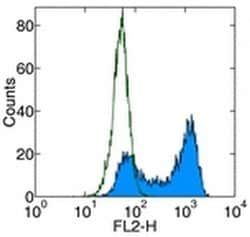
- Applications Tested: This DX2 antibody has been pre-titrated and tested by flow cytometric analysis of normal human peripheral blood cells
- This can be used at 5 μL (0.125 μg) per test
- A test is defined as the amount (μg) of antibody that will stain a cell sample in a final volume of 100 μL
- Cell number should be determined empirically but can range from 10^5 to 10^8 cells/test
- Excitation: 488-561 nm; Emission: 578 nm; Laser: Blue Laser, Green Laser, Yellow-Green Laser
- Filtration: 0.2 μm post-manufacturing filtered
- FAS (Fas, CD95, APO-1) is a 46 kDa transmembrane glycoprotein that functions as a cell death receptor of the TNFR (tumor necrosis factor receptor) superfamily
- FAS also exists in a soluble form that weight approximately 26kDa
- Stimulation of FAS results in aggregation of its intracellular FAS-associated death domains (FADD), formation of the death-inducing signaling complex (DISC) and activation of caspases
- The auto-proteolytic processing of the caspases in the complex trigger a downstream cascade that leads to apoptosis
- FAS has been shown to activate NF-kappaB, MAPK3/ERK1, MAPK8/JNK, and is involved in transducing the proliferating signals in normal diploid fibroblast and T cells
- At least eight alternatively spliced transcript variants encoding seven distinct isoforms have been described
- The isoforms lacking the transmembrane domain may negatively regulate the apoptosis mediated by the full-length isoform
- The Fas/Fas ligand system has been shown to play a role in a number of human diseases such as AIDS, hepatitis and cancer
- It is also assumed that induction of apoptosis through FAS ligand pathway is predominantly involved in anti-viral immune responses.