Ea52-68 peptide bound to I-Ab Monoclonal Antibody (eBioY-Ae (YAe, Y-Ae)), eBioscience™, Invitrogen™
Mouse Monoclonal Antibody
Manufacturer: Fischer Scientific
The price for this product is unavailable. Please request a quote
Antigen
Ea52-68 peptide bound to I-Ab
Concentration
0.5 mg/mL
Classification
Monoclonal
Form
Liquid
Regulatory Status
RUO
Formulation
PBS with 0.09% sodium azide; pH 7.2
Gene Alias
Abeta; AI845868; H-2 class II histocompatibility antigen, A beta chain; H-2Ab; H2-Ab; H2-Ab1; H2Eb; H-2Eb; H2-iabeta; histocompatibility 2, class II antigen A, beta 1; Ia2; Ia-2; Ia4; Ia-4; IAb; I-Abeta; major histocompatibility complex class II beta chain; MGC163794; MGC163796; MHC class II antigen A beta; MHC class II H2-IA-beta-psi; response to metastatic cancers 1; Rmcs1
Gene Symbols
H2-Ab1
Primary or Secondary
Primary
Content And Storage
4° C
Gene
H2-Ab1
Clone
eBioY-Ae (YAe, Y-Ae), Y-Ae)
Applications
Flow Cytometry
Conjugate
Unconjugated
Host Species
Mouse
Target Species
Mouse
Gene Accession No.
P01921, P06342, P06343, P06344, P06345, P06346, P14483
Gene ID (Entrez)
14961
Isotype
IgG2b
Purification Method
Affinity chromatography
Product Type
Antibody
Related Products

Description
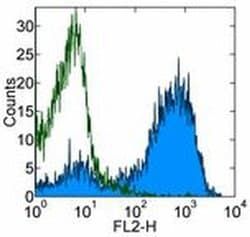
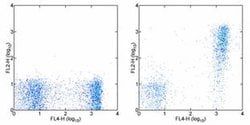
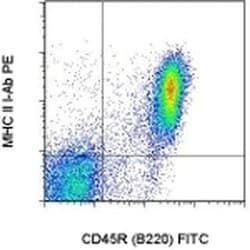
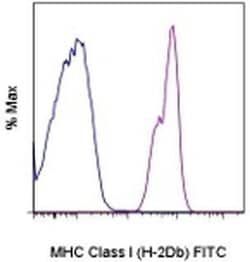
- Description: The Y-Ae antibody reacts with a class II major histocompatibility complex (MHC) self Ea peptide (peptide 52-68) bound to I-Ab molecules
- The Y-Ae antibody detects a determit expressed on a subset of class II I-Ab molecules in strains that also express class II I-Eb
- This determit is expressed on peripheral B cells and on cells in the thymic medulla, but not thymic cortical epithelium
- In addition to B cells, the Y-Ae determit is expressed at comparable levels on other antigen presenting cells, including macrophages and dendritic cells
- The antibody does not react with invariant chain-associated class II MHC complexes
- The reactivity of the Y-Ae antibody is MHC-restricted
- The Y-Ae antibody was generated by immunization of [B10.MBR x B10.D2]F1 recipients with B10A(5R) LPS blasts
- In this strain combination, there is incompatibility for I-Ab and I-Eb molecules
- The antibody reacts with 10-15% of surface I-Ab molecules in strains that also express surface I-Eb molecules (e.g., strains B10.A(5R) and B10.A(3R))
- The antibody does not react with I-A molecules in strains that have a non-functional I-E (a chain) gene (e.g., strains B6 and B10), nor with mutant I-A molecules (e.g., (B6.c-H-2bm-12 x A.TFR5)F1), nor with any other strain tested
- The Y-Ae antibody recognizes an Ea peptide (Ea 52-68) bound to I-Ab molecules, but not to Ea 52-68 peptide bound to I-Ak or I-Abm-12 molecules
- MHC class II molecules are heterodimers of non-covalently associated alpha (31-34 kDa) and beta (26-29 kDa) chains
- Major histocompatibility complex class II antigen presentation requires the participation of lysosomal proteases in two convergent processes
- First, the antigens endocytosed by the antigen presenting cells must be broken down into antigenic peptides
- Second, class II molecules are synthesized with their peptide-binding site blocked by invariant chain (Ii), and they aquire the capacity to bind antigens only after Ii has been degraded in the compartments where peptides reside
- MHC class II molecules present exogenously derived antigen to CD4+ T lymphocytes, which are usually T helper cells
- CD4 interacts with non-polymorphic residues of MHC class II
- HLA and MHC antibodies play a significant role in Immunopeptidomics, facilitating the identification and characterization of neoantigens through high-performance liquid chromatography coupled to tandem Mass Spectrometry.