CD154 (CD40 Ligand) Monoclonal Antibody (MR1), APC, eBioscience™, Invitrogen™
Armenian Hamster Monoclonal Antibody
Manufacturer: Fischer Scientific
The price for this product is unavailable. Please request a quote
Antigen
CD154 (CD40 Ligand)
Concentration
0.2 mg/mL
Classification
Monoclonal
Form
Liquid
Regulatory Status
RUO
Formulation
PBS with 0.09% sodium azide; pH 7.2
Gene Alias
CD154; CD40 antigen ligand; CD40 ligand; CD40 ligand CD154; CD40 ligand, membrane form; CD40 ligand, soluble form; CD40L; CD40-L; Cd40lg; gp39; hCD40L; H-CD-40-L; HIGM1; IGM; IMD3; Ly62; Ly-62; M-CD-40-L; RP23-153G22.3; T-B cell-activating molecule; T-BAM; T-cell antigen Gp39; TNF-related activation protein; TNFSF5; TRAP; tumor necrosis factor (ligand) superfamily member 5; tumor necrosis factor (ligand) superfamily, member 5; tumor necrosis factor ligand superfamily member 5
Gene Symbols
CD40LG
Primary or Secondary
Primary
Content And Storage
4° C, store in dark, DO NOT FREEZE!
Gene
CD40LG
Clone
MR1
Applications
Flow Cytometry
Conjugate
APC
Host Species
Armenian Hamster
Target Species
Mouse
Gene Accession No.
P27548
Gene ID (Entrez)
21947
Isotype
IgG
Purification Method
Affinity chromatography
Product Type
Antibody
Related Products
Description
- Description: The MR1 monoclonal antibody reacts with mouse CD154, a 39 kDa transmembrane glycoprotein also known as CD40 ligand (CD40L)
- CD154 is expressed transiently by activated T cells
- Through its binding to CD40 on antigen presenting cells (APC) including B cells, monocytes/macrophages, and dendritic cells, it serves a crucial function in T cell-APC cognate interaction
- CD154-interaction with CD40 transduces signals for T-dependent B cell activation and induces B cells to enter the cell cycle
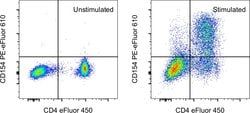
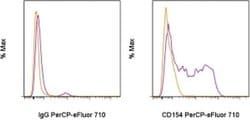
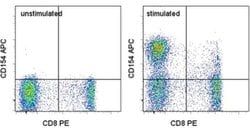
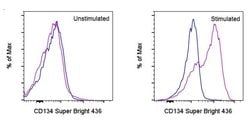
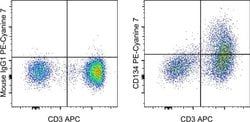
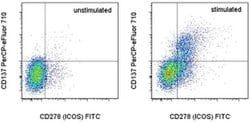
- For staining for flow cytometric analysis, it is important to stimulate enriched T cells or enriched CD4 cells (using depletion strategy) prior to staining with MR1
- Applications Reported: This MR1 antibody has been reported for use in flow cytometric analysis
- Applications Tested: This MR1 antibody has been tested by flow cytometric analysis of stimulated mouse splenocytes
- This can be used at less than or equal to 0.25 μg per test
- A test is defined as the amount (μg) of antibody that will stain a cell sample in a final volume of 100 μL
- Cell number should be determined empirically but can range from 10^5 to 10^8 cells/test
- It is recommended that the antibody be carefully titrated for optimal performance in the assay of interest
- Excitation: 633-647 nm; Emission: 660 nm; Laser: Red Laser
- Filtration: 0.2 μm post-manufacturing filtered
- CD40 Ligand (CD40-L), or CD154, is a membrane glycoprotein and differentiation antigen expressed on the surface of T cells
- The CD40 Ligand stimulates B cell proliferation and secretion of all immunoglobulin isotypes in the presence of cytokines
- CD40 Ligand has been shown to induce cytokine production and tumoricidal activity in peripheral blood monocytes
- It also co-stimulates proliferation of activated T cells and this is accompanied by the production of IFN-gamma, TNF-alpha, and IL-2.