ROR gamma (t) Monoclonal Antibody (AFKJS-9), PE, eBioscience™, Invitrogen™
Rat Monoclonal Antibody
Manufacturer: Fischer Scientific
The price for this product is unavailable. Please request a quote
Antigen
ROR gamma (t)
Concentration
0.2 mg/mL
Classification
Monoclonal
Form
Liquid
Regulatory Status
RUO
Formulation
PBS with 0.09% sodium azide; pH 7.2
Gene Alias
EGK_01272; IMD42; MGC129539; NR1F3; nuclear receptor ROR-gamma; Nuclear receptor RZR-gamma; nuclear receptor subfamily 1 group F member 3; RAR related orphan receptor C; RAR-related orphan nuclear receptor variant 2; RAR-related orphan receptor C; RAR-related orphan receptor C, isoform a; RAR-related orphan receptor gamma; retinoic acid-binding receptor gamma; retinoid-related orphan receptor gamma; retinoid-related orphan receptor-gamma; ROR Gamma; ROR gamma t; Rorc; Rorg; RORgamma; RORgt; RP11-98D18.11-001; RZRG; RZR-GAMMA; Thor; Thymus orphan receptor; TOR
Gene Symbols
Rorc
Primary or Secondary
Primary
Content And Storage
4° C, store in dark, DO NOT FREEZE!
Gene
Rorc
Clone
AFKJS-9
Applications
Flow Cytometry
Conjugate
PE
Host Species
Rat
Target Species
Human, Mouse, Rhesus Monkey
Gene Accession No.
P51449, P51450
Gene ID (Entrez)
19885, 6097, 717052
Isotype
IgG2a κ
Purification Method
Affinity chromatography
Product Type
Antibody
Related Products

Description
- Description: The AFKJS-9 monoclonal antibody reacts with the mouse, human and rhesus monkey ROR gamma (t) protein
- ROR gamma is a member of the retinoic acid-related orphan receptor (ROR) family, which also includes ROR alpha and ROR beta
- ROR family proteins are ligand-dependent transcription factors that play roles in multiple physiological processes
- ROR gamma is expressed in several tissues including liver, lung, muscle, heart and kidney
- Furthermore, it was discovered that alternative transcription results in the expression of an isoform, ROR gamma (t), which is expressed exclusively in cells of the lymphoid compartment, namely CD4+CD8+ double-positive thymocytes, Th17 cells of the periphery and lymphoid tissue inducer (LTi) cells of lymphoid organs
- The ROR gamma (t) isoform differs from ROR gamma by three unique amino acids at its amino terminus
- Therefore, the AFKJS-9 antibody will react with both the ROR gamma and ROR gamma (t) isoforms
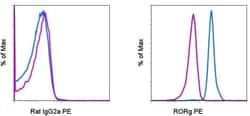
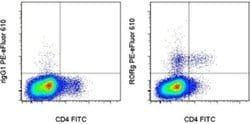
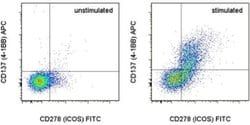
- Applications Reported: This AFKJS-9 antibody has been reported for use in intracellular staining followed by flow cytometric analysis
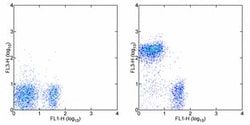
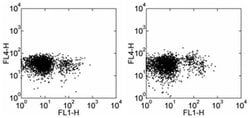
- Applications Tested: This AFKJS-9 antibody has been tested by intracellular staining followed by flow cytometric analysis of mouse thymocytes and Th17-polarized splenocytes using the Foxp3/Transcription Factor Staining Buffer Set (cat
- 00-5523-00) and protocol
- ROR gamma, a NR1 Thyroid Hormone-Like receptor, has been shown to affect thymopoiesis, bone metabolism, T-cell apoptosis, and lymphoid organogenesis
- ROR gamma has been shown to promote thymocyte survival by activating the expression of the antiapoptotic protein Bcl-x(L)
- ROR gamma is also required for the development of lymph nodes and Peyer's patches
- It has been shown that ROR gamma(t), a thymus-specific isoform of ROR gamma from mouse, inhibits Fas ligand expression and cytokine secretion in immature thymocytes
- ROR gamma binds as a monomer to response elements composed of a single core motif, GGTCA, preceded by a 6 bp AT-rich sequence
- ROR gamma expression has been documented in mouse thymus, adipose, bone, skeletal muscle, liver, and kidney, and in human skeletal muscle
- ESTs have been isolated from human tissue libraries, including cancerous head/neck, germ cell, and prostate, and normal colon, head/neck, lung, liver/spleen, and pancreas
- ROR gammat t (RORgt) is an isoform of RORC.