CD23 Monoclonal Antibody (EBVCS2), Super Bright™ 436, eBioscience™, Invitrogen™
Mouse Monoclonal Antibody
Manufacturer: Fischer Scientific
The price for this product is unavailable. Please request a quote
Antigen
CD23
Concentration
5 μL/Test
Classification
Monoclonal
Form
Liquid
Regulatory Status
RUO
Formulation
PBS with BSA and 0.09% sodium azide
Gene Alias
BLAST-2; CD23; CD23 antigen; CD23A; CLEC4J; C-type lectin domain family 4 member J; C-type lectin domain family 4, member J; Fc epsilon receptor II; FC epsilon RII; Fc fragment of IgE receptor II; Fc fragment of IgE, low affinity II, receptor for (CD23); Fc receptor alpha multiple ligand receptor; Fc receptor, IgE, low affinity II, alpha polypeptide; Fcalpha muR; Fcalpha RII; Fce2; fc-epsilon-RII; FCER2; Fcer2a; FceRII; IGEBF; Immunoglobulin E-binding factor; immunoglobulin epsilon-chain; low affinity immunoglobulin epsilon Fc receptor; Low affinity immunoglobulin epsilon Fc receptor membrane-bound form; Low affinity immunoglobulin epsilon Fc receptor soluble form; low-affinity IgE receptor; Ly-42; lymphocyte IgE receptor
Gene Symbols
FCER2
Primary or Secondary
Primary
Content And Storage
4° C, store in dark, DO NOT FREEZE!
Gene
FCER2
Clone
EBVCS2
Applications
Flow Cytometry
Conjugate
Super Bright 436
Host Species
Mouse
Target Species
Human
Gene Accession No.
P06734
Gene ID (Entrez)
2208
Isotype
IgG1 κ
Purification Method
Affinity chromatography
Product Type
Antibody
Related Products
Description
- The EBVCS2 monoclonal antibody reacts with human CD23, a 45 kDa type II transmembrane glycoprotein
- CD23 is expressed on mature B cells, mantle zone B cells, follicular dendritic cells and at low levels on T, NK, langerhans cells and platelets
- Expression of CD23 is upregulated upon B cell activation, and soluble forms of the antigen have been reported to be biologically active
- CD23 is a low affinity receptor for IgE and is thought to play a role in the regulation of IgE response and B cell activation
- CD21 and the alpha subunit of CD11b and CD11c bind to CD23
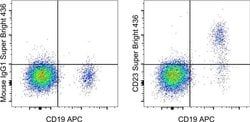
- This EBVCS2 antibody has been pre-titrated and tested by flow cytometric analysis of normal human peripheral blood cells
- This can be used at 5 μL (0.25 μg) per test
- A test is defined as the amount (μg) of antibody that will stain a cell sample in a final volume of 100 μL
- Cell number should be determined empirically but can range from 10^5 to 10^8 cells/test
- Super Bright 436 can be excited with the violet laser line (405 nm) and emits at 436 nm
- We recommend using a 450/50 bandpass filter, or equivalent
- Please make sure that your instrument is capable of detecting this fluorochrome
- When using two or more Super Bright dye-conjugated antibodies in a staining panel, it is recommended to use Super Bright Complete Staining Buffer (Product No
- SB-4401) to minimize any non-specific polymer interactions
- CD23 is a 45 kDa glycoprotein which is present on a subpopulation of freshly isolated peripheral blood and tonsil B cells and strongly expressed on EBV-transformed B lymphoblasts
- The CD23 molecule is identical to the low affinity IgE receptor found on B cells
- Expression of CD23 has been detected in neoplastic cells from cases of B cell chronic lymphocyctic leukaemia and some cases of centroblastic/centrocytic lymphoma
- CD23 is present on a subpopulation of freshly isolated peripheral blood and tonsil B cells and strongly expressed on EBV-transformed B lymphoblasts
- Functionally, CD23 is involved in B cell growth and differentiation, and IgE production
- Further, CD23 has a soluble form that is a potent mitogenic factor
- Diseases associated with CD23 dysfunction include chronic conjunctivitis and chronic lymphocytic leukemia.