7144007
CENP-F/Mitosin Polyclonal Antibody, Bethyl Laboratories
Rabbit Polyclonal Antibody
Manufacturer: Fischer Scientific
The price for this product is unavailable. Please request a quote
Antigen
CENP-F/Mitosin
Classification
Polyclonal
Form
Liquid
Regulatory Status
RUO
Formulation
TBS with 0.1% BSA and 0.09% sodium azide
Gene Alias
RP11-262H5.1, CENF, PRO1779, hcp-1
Gene Symbols
CENPF
Isotype
IgG
Purification Method
Antigen affinity chromatography
Product Type
Antibody
Applications
Immunocytochemistry, Immunofluorescence
Conjugate
Unconjugated
Host Species
Rabbit
Target Species
Human
Gene Accession No.
P49454
Gene ID (Entrez)
1063
Immunogen
Between 1800 and 1850
Primary or Secondary
Primary
Content And Storage
4° C
Gene
CENPF
Related Products


Description
- The recommended shelf life for this product is 1 year from date of receipt
- Based on 100% sequence identity, this antibody is predicted to react with Orangutan, Gorilla, Chimpanzee and Northern white-cheeked gibbon This gene encodes a protein that associates with the centromere-kinetochore complex
- The protein is a component of the nuclear matrix during the G2 phase of interphase
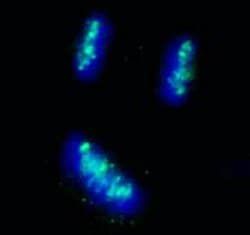
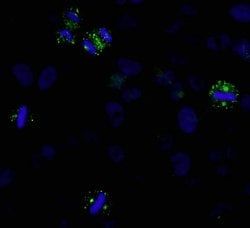
- In late G2 the protein associates with the kinetochore and maintains this association through early anaphase
- It localizes to the spindle midzone and the intracellular bridge in late anaphase and telophase, respectively, and is thought to be subsequently degraded
- The localization of this protein suggests that it may play a role in chromosome segregation during mitotis
- It is thought to form either a homodimer or heterodimer
- Autoantibodies against this protein have been found in patients with cancer or graft versus host disease.