7143991
CTCF Polyclonal Antibody, Bethyl Laboratories
Rabbit Polyclonal Antibody
Manufacturer: Fischer Scientific
The price for this product is unavailable. Please request a quote
Antigen
CTCF
Classification
Polyclonal
Form
Liquid
Regulatory Status
RUO
Formulation
TBS with 0.1% BSA and 0.09% sodium azide
Gene Alias
CTCF
Gene Symbols
CTCF
Isotype
IgG
Purification Method
Antigen affinity chromatography
Product Type
Antibody
Applications
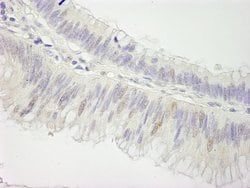
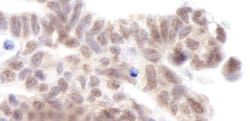
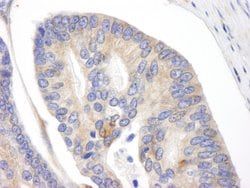
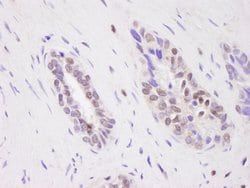
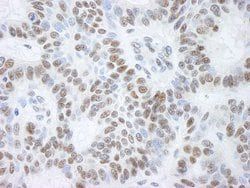
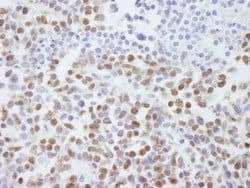
Immunohistochemistry
Conjugate
Unconjugated
Host Species
Rabbit
Target Species
Human
Gene Accession No.
P49711
Gene ID (Entrez)
10664
Immunogen
Between 650 and 700
Primary or Secondary
Primary
Content And Storage
4° C
Gene
CTCF
Related Products


Description
- The recommended shelf life for this product is 1 year from date of receipt
- Based on 100% sequence identity, this antibody is predicted to react with Mouse, Rat, Bovine, Pig, Orangutan, Monkey, Gorilla, Chimpanzee, Northern white-cheeked gibbon an This gene is a member of the BORIS + CTCF gene family and encodes a transcriptional regulator protein with 11 highly conserved zinc finger (ZF) domains
- This nuclear protein is able to use different combinations of the ZF domains to bind different DNA target sequences and proteins
- Depending upon the context of the site, the protein can bind a histone acetyltransferase (HAT)-containing complex and function as a transcriptional activator or bind a histone deacetylase (HDAC)-containing complex and function as a transcriptional repressor
- If the protein is bound to a transcriptional insulator element, it can block communication between enhancers and upstream promoters, thereby regulating imprinted expression
- Mutations in this gene have been associated with invasive breast cancers, prostate cancers, and Wilms' tumors.Tissue specificity: Ubiquitous
- Absent in primary spermatocytes.