7144062
AF9 Polyclonal Antibody, Bethyl Laboratories
Rabbit Polyclonal Antibody
Manufacturer: Fischer Scientific
The price for this product is unavailable. Please request a quote
Antigen
AF9
Classification
Polyclonal
Form
Liquid
Regulatory Status
RUO
Formulation
TBS with 0.1% BSA and 0.09% sodium azide
Gene Alias
AF-9 protein
Gene Symbols
MLLT3
Isotype
IgG
Purification Method
Antigen affinity chromatography
Product Type
Antibody
Applications
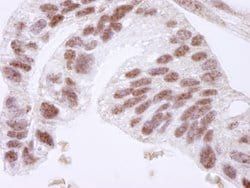
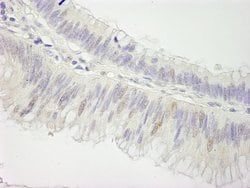
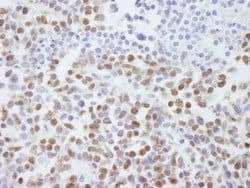
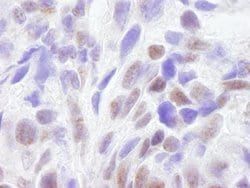
Immunohistochemistry
Conjugate
Unconjugated
Host Species
Rabbit
Target Species
Human
Gene Accession No.
P42568
Gene ID (Entrez)
4300
Immunogen
Between 250 and 300
Primary or Secondary
Primary
Content And Storage
4° C
Gene
MLLT3
Related Products

Description
- The recommended shelf life for this product is 1 year from date of receipt
- Based on 100% sequence identity, this antibody is predicted to react with Bovine, Dog, Horse, Rabbit, Pig, Orangutan, Monkey, Gorilla, Chimpanzee, Northern white-cheeked g The human AF9 gene is one of the most common fusion partner genes with the ALL1 gene at 11q23 (also called MLL), resulting in the t(9;11)(p22;q23)
- The AF9 gene is more than 100 kb, and 2 patient breakpoint cluster regions (BCRs) have been identified; BCR1 is within intron 4, previously called site A, whereas BCR2 or site B spans introns 7 and 8
- Several different structural elements have been identified in AF9, including a colocalizing in vivo DNA topo II cleavage site and an in vitro DNase I hypersensitive (DNase 1 HS) site in intron 7 in BCR2
- Reversibility experiments demonstrated a religation of the topo II cleavage sites
- In addition, 2 scaffold associated regions (SARs) are located centromeric to the topo II and DNase I HS cleavage sites and border breakpoint regions in 2 leukemic cells lines: SAR1 is located in intron 4, whereas SAR2 encompasses parts of exons 5-7
- The patient breakpoint regions of AF9 share the same structural elements as the MLL BCR
- A DNA breakage and repair model for nonhomologous recombination between MLL and its partner genes, particularly AF9, has been proposed.