7144130
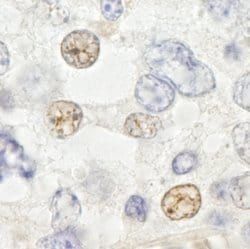
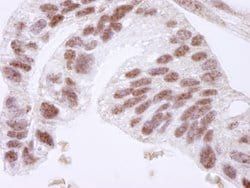
RecQ1 Polyclonal Antibody, Bethyl Laboratories
Rabbit Polyclonal Antibody
Manufacturer: Fischer Scientific
The price for this product is unavailable. Please request a quote
Antigen
RecQ1
Classification
Polyclonal
Form
Liquid
Regulatory Status
RUO
Formulation
TBS with 0.1% BSA and 0.09% sodium azide
Gene Alias
RECQL1, RecQ1, ATP-dependent DNA helicase Q1; DNA helicase, RecQ-like type 1; DNA-dependent ATPase Q1; recQ protein-like 1
Gene Symbols
RECQL
Isotype
IgG
Purification Method
Antigen affinity chromatography
Product Type
Antibody
Applications
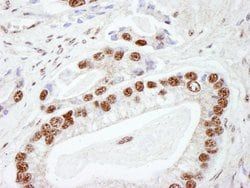
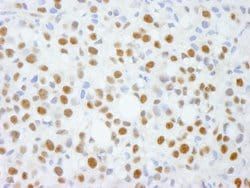
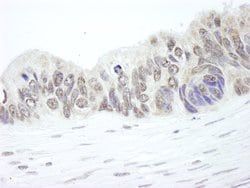
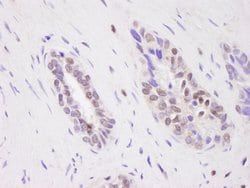
Immunohistochemistry
Conjugate
Unconjugated
Host Species
Rabbit
Target Species
Human
Gene Accession No.
P46063
Gene ID (Entrez)
5965
Immunogen
Between 600 and C-term
Primary or Secondary
Primary
Content And Storage
4° C
Gene
RECQL
Related Products

Description
- The recommended shelf life for this product is 1 year from date of receipt
- Based on 100% sequence identity, this antibody is predicted to react with Orangutan, Monkey, Gorilla, Chimpanzee, Northern white-cheeked gibbon, hirteen-lined ground squir The protein encoded by this gene is a member of the RecQ DNA helicase family
- DNA helicases are enzymes involved in various types of DNA repair, including mismatch repair, nucleotide excision repair and direct repair
- Some members of this family are associated with genetic disorders with predisposition to maligcy and chromosomal instability
- The biological function of this helicase has not yet been determined
- Two alternatively spliced transcripts, which encode the same isoform but differ in their 5' and 3' UTRs, have been described.