7144283
WTAP Polyclonal Antibody, Bethyl Laboratories
Rabbit Polyclonal Antibody
Manufacturer: Fischer Scientific
The price for this product is unavailable. Please request a quote
Antigen
WTAP
Classification
Polyclonal
Form
Liquid
Regulatory Status
RUO
Formulation
TBS with 0.1% BSA and 0.09% sodium azide
Gene Alias
PNAS-132, WT1-associated protein, Wilms′ tumour 1-associating protein, female-lethal(2)D homolog, hFL(2)D, pre-mRNA-splicing regulator WTAP, putative pre-mRNA splicing regulator female-lethal(2D), wilms tumor 1-associating protein
Gene Symbols
WTAP
Isotype
IgG
Purification Method
Antigen affinity chromatography
Product Type
Antibody
Applications
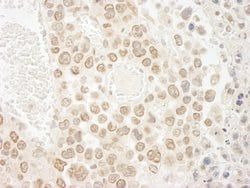
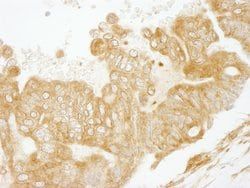
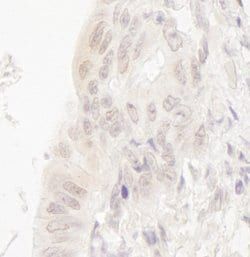
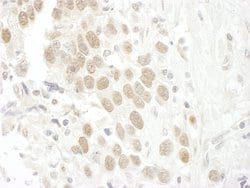
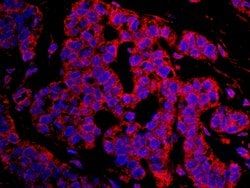
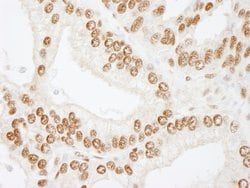
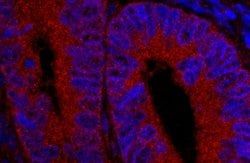
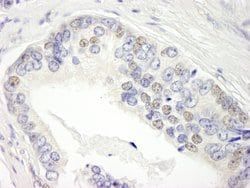
Immunofluorescence, Immunohistochemistry
Conjugate
Unconjugated
Host Species
Rabbit
Target Species
Human
Gene Accession No.
Q15007
Gene ID (Entrez)
9589
Immunogen
Between 346 and 396
Primary or Secondary
Primary
Content And Storage
4° C
Gene
WTAP
Related Products
Description
- The recommended shelf life for this product is 1 year from date of receipt
- Based on 100% sequence identity, this antibody is predicted to react with X
- laevis, X
- tropicalis, Bovine, Horse, Guinea pig_10141, Pig, Panda, Orangutan, Monkey, The Wilms tumor suppressor gene WT1 appears to play a role in both transcriptional and posttranscriptional regulation of certain cellular genes
- This gene encodes a WT1-associating protein, which is a ubiquitously expressed nuclear protein
- Like WT1 protein, this protein is localized throughout the nucleoplasm as well as in speckles and partially colocalizes with splicing factors
- Alternative splicing of this gene results in three transcript variants, two of which encode the same isoform.