BRG1/SMARCA4 Polyclonal Antibody, Bethyl Laboratories
Rabbit Polyclonal Antibody
Manufacturer: Fischer Scientific
The price for this product is unavailable. Please request a quote
Antigen
BRG1/SMARCA4
Classification
Polyclonal
Form
Liquid
Regulatory Status
RUO
Formulation
TBS with 0.1% BSA and 0.09% sodium azide
Gene Alias
ATP-dependent helicase SMARCA4; BAF190A; BRG1-associated factor 190A; BRM/SWI2-related gene 1; SNF2-like 4; SWI/SNF-related matrix-associated actin-dependent regulator of chromatin subfamily A member 4; brahma protein-like 1; global transcription activator homologous sequence; homeotic gene regulator; mitotic growth and transcription activator; nuclear protein GRB1; protein BRG-1; protein brahma homolog 1; sucrose nonfermenting-like 4; transcription activator BRG1
Immunogen
Between 75 and 125
Primary or Secondary
Primary
Content And Storage
4° C
Gene
SMARCA4
Applications
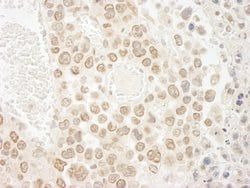
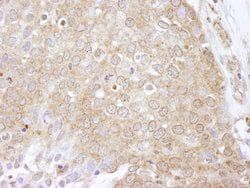
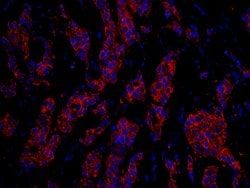
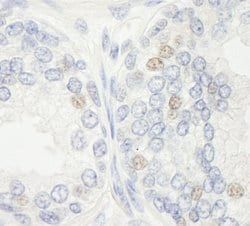
Immunohistochemistry
Conjugate
Unconjugated
Host Species
Rabbit
Target Species
Human, Mouse
Gene Accession No.
P51532, Q3TKT4
Gene ID (Entrez)
20586, 6597
Isotype
IgG
Purification Method
Antigen affinity chromatography
Product Type
Antibody
Related Products

Description
- The recommended shelf life for this product is 1 year from date of receipt
- Based on 100% sequence identity, this antibody is predicted to react with Dog, Horse, Rabbit, Panda, Orangutan, Monkey, Gorilla, Chimpanzee, Gray short-tailed opossum and Brg1 (Brahma-related gene 1) is an ATPase subunit of SWI2/SNF2-like chromatin-remodeling complexes that enable access of regulatory and effector proteins in transcription, DNA repair and DNA replication
- Although Brg1-containing complexes are not essential for general cell survival, they participate in transcriptional regulation of several hundred genes including those involved in interferon and stress response, immune cells differentiation, neurogenesis, cell cycle etc
- and is absolutely necessary for mouse embryogenesis
- Brg1 is also involved in cell growth arrest, senescence and tumour supression.