7144439
SRcyp Polyclonal Antibody, Bethyl Laboratories
Rabbit Polyclonal Antibody
Manufacturer: Fischer Scientific
The price for this product is unavailable. Please request a quote
Antigen
SRcyp
Classification
Polyclonal
Form
Liquid
Regulatory Status
RUO
Formulation
TBS with 0.1% BSA and 0.09% sodium azide
Gene Alias
CARS-cyclophilin; CASP10; Clk-associating RS-cyclophilin; OTTHUMP00000204761; OTTHUMP00000204762; PPIase G; SR-cyclophilin; SR-cyp; SR-related CTD-associated factor 10; cyclophilin G; peptidyl-prolyl cis-trans isomerase G; peptidyl-prolyl isomerase G (cyclophilin G); rotamase G
Immunogen
Between 450 and 500
Primary or Secondary
Primary
Content And Storage
4° C
Gene
PPIG
Applications
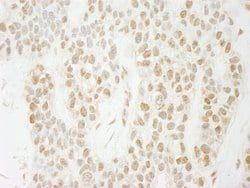
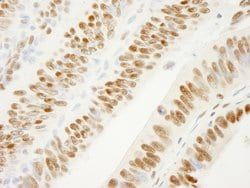
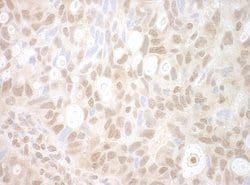
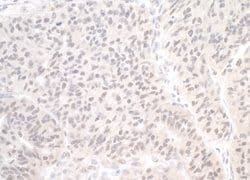
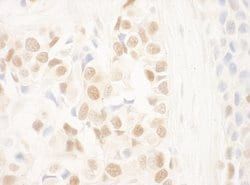
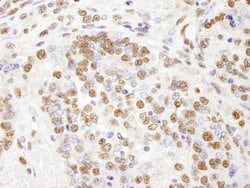
Immunohistochemistry
Conjugate
Unconjugated
Host Species
Rabbit
Target Species
Human, Mouse
Gene Accession No.
A2AR02, Q13427
Gene ID (Entrez)
228005, 9360
Isotype
IgG
Purification Method
Antigen affinity chromatography
Product Type
Antibody
Related Products
Description
- The recommended shelf life for this product is 1 year from date of receipt
- Based on 100% sequence identity, this antibody is predicted to react with Orangutan and Chimpanzee PPIG belongs to a highly conserved class of cyclophilins that function as peptidyl-prolyl-isomerases (PPIases) to catalyze the conversion of cis-proline to trans-proline in a polypeptide chain
- PPIG contains an amino-terminal cyclophilin domain followed by Nopp140 repeats that are involved in its function as a nuclear chaperone
- The carboxy-terminal of PPIG contains a SR (arginine-serine dipeptide repeat) domain that is involved in pre-mRNA splicing and processing
- PPIG interacts with the carboxy-terminal domain of RNA polymerase II as well as several other SR family splicing factors
- These interactions lead to changes in localization and conformation and suggest a regulatory role in transcription and pre-mRNA splicing in the elongating RNA polymerase complex
- PPIG is found in the nuclear matrix and nuclear speckles and is involved in the regulation of gene expression
- PPIG shows a predomitly diffuse cytoplasmic distribution at the onset of mitosis, and in late telophase the isomerase is recruited to the newly formed nuclei.