7144448
PA1 Polyclonal Antibody, Bethyl Laboratories
Rabbit Polyclonal Antibody
Manufacturer: Fischer Scientific
The price for this product is unavailable. Please request a quote
Antigen
PA1
Classification
Polyclonal
Form
Liquid
Regulatory Status
RUO
Formulation
TBS with 0.1% BSA and 0.09% sodium azide
Gene Alias
GAS, PA1; PAXIP1-associated protein 1; PTIP-associated 1 protein; PTIP-associated protein 1; glutamate-rich coactivator interacting with SRC1/NCOA1
Gene Symbols
PAGR1
Isotype
IgG
Purification Method
Antigen affinity chromatography
Product Type
Antibody
Applications
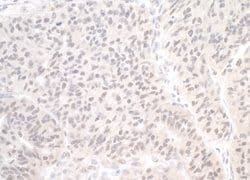
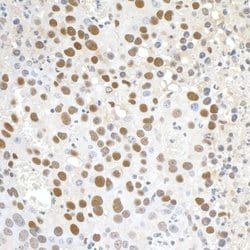
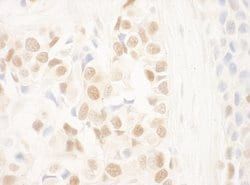
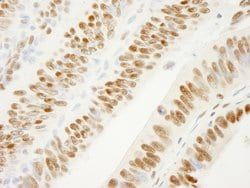
Immunohistochemistry
Conjugate
Unconjugated
Host Species
Rabbit
Target Species
Human
Gene Accession No.
Q9BTK6
Gene ID (Entrez)
79447
Immunogen
Between 204 and 254
Primary or Secondary
Primary
Content And Storage
4° C
Gene
PAGR1
Related Products
Description
- The recommended shelf life for this product is 1 year from date of receipt
- Based on 100% sequence identity, this antibody is predicted to react with Horse, Orangutan, Monkey, Gorilla, Chimpanzee, Little brown bat, hirteen-lined ground squirrel an Steroid receptor co-activators (SRCs) were initially described as nuclear receptor transcription co-activators, but they have recently been determined to co-regulate transcription initiated by other transcription factors
- GAS is a recently identified glutamate-rich protein that interacts with SRC1, but not GRIP1 or AIB1, the other two members of the SRC family
- GAS can also interact with the alpha subunit of the estrogen receptor (ERalpha), but not other receptors such as the retinoic acid receptor a, suggesting the interaction between GAS and ERalpha is relatively specific
- Depletion of GAS by RNA interference in MCF7 cells led to a decrease in the mRNA and protein levels of ER target genes such as pS2, c-Myc and cyclin D1, indicating the role of GAS in the regulation of ER target genes
- GAS has also been found to associate with an SET1-like methyltransferase complex specific for H3K4 methylation, suggesting that GAS has multiple roles in transcriptional regulation.