7144453
eIF4G1/eIF4GI Polyclonal Antibody, Bethyl Laboratories
Rabbit Polyclonal Antibody
Manufacturer: Fischer Scientific
The price for this product is unavailable. Please request a quote
Antigen
eIF4G1/eIF4GI
Classification
Polyclonal
Form
Liquid
Regulatory Status
RUO
Formulation
TBS with 0.1% BSA and 0.09% sodium azide
Gene Alias
DKFZp686A1451, EIF4F, EIF4G, p220
Immunogen
Between 525 and 575
Primary or Secondary
Primary
Content And Storage
4° C
Gene
EIF4G1
Applications
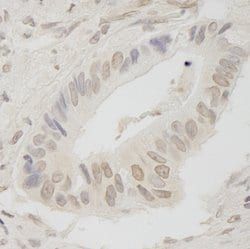
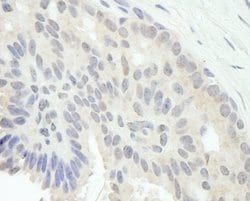
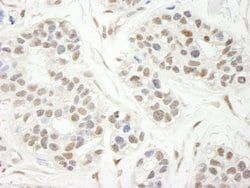
Immunohistochemistry
Conjugate
Unconjugated
Host Species
Rabbit
Target Species
Human, Mouse
Gene Accession No.
Q04637, Q6NZJ6
Gene ID (Entrez)
1981, 208643
Isotype
IgG
Purification Method
Antigen affinity chromatography
Product Type
Antibody
Related Products

Description
- The recommended shelf life for this product is 1 year from date of receipt
- Based on 100% sequence identity, this antibody is predicted to react with Monkey, Chimpanzee and Crab-eating macaque The protein encoded by this gene is a component of the multi-subunit protein complex EIF4F
- This complex facilitates the recruitment of mRNA to the ribosome, which is a rate-limiting step during the initiation phase of protein synthesis
- The recognition of the mRNA cap and the ATP-dependent unwinding of 5'-terminal secondary structure is catalyzed by factors in this complex
- The subunit encoded by this gene is a large scaffolding protein that contains binding sites for other members of the EIF4F complex
- A domain at its N-terminus can also interact with the poly-binding protein, which may mediate the circularization of mRNA during translation
- Alternative splicing results in multiple transcript variants, some of which are derived from alternative promoter usage.