Vesicular Glutamate Transporter 3 (VGLUT3), Rabbit anti-Mouse, Human, Rat, Polyclonal, Millipore Sigma™
Rabbit Polyclonal Antibody
Manufacturer: Fischer Scientific
The price for this product is unavailable. Please request a quote
Antigen
Vesicular Glutamate Transporter 3 (VGLUT3)
Applications
Immunocytochemistry, Immunohistochemistry (Paraffin), Western Blot
Conjugate
Unconjugated
Regulatory Status
RUO
Target Species
Mouse, Human, Rat
Gene Alias
Solute carrier family 17 member 8;VGluT3
Immunogen
KLH-conjugated linear peptide corresponding to 13 amino acids from the C-terminal region of rat Vesicular glutamate transporter 3 (VGluT3).
Purification Method
Affinity Purified
Test Specificity
This rabbit polyclonal antibody specifically detects Vesicular glutamate transporter 3(VGluT3). It targets an epitope with in 13 amino acids from the C-terminal region.
Dilution
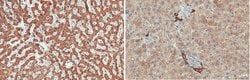
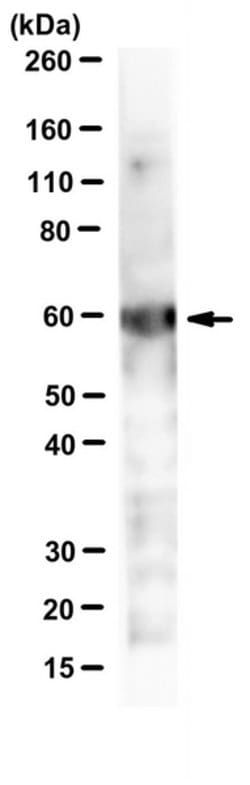
Western Blotting Analysis: A 1:500 dilution from a representative lot detected Vesicular Glutamate Transporter 3 (VGLUT3) in PC12 cell lysate.Immunohistochemistry (Paraffin) Analysis: A 1:250 dilution from a representative lot detected Vesicular Glutamate Transporter 3 (VGLUT3) in rat brain and human brain tissue sections.Immunocytochemistry Analysis: A 1:1,000 dilution from a representative lot detected Vesicular Glutamate Transporter 3 (VGLUT3) in PC12 cells.
Classification
Polyclonal
Host Species
Rabbit
Research Discipline
Neuroscience
Formulation
Purified rabbit polyclonal antibody in buffer containing 0.1 M Tris-Glycine (pH 7.4), 150 mM NaCl with 0.05% sodium azide.
Gene Symbols
Slc17a8;Vglut3
Primary or Secondary
Primary
Content And Storage
Stable for 1 year at 2-8°C from date of receipt.
Molecular Weight of Antigen
∽ 60 kDa observed; 64.76 kDa calculated. Uncharacterized bands may be observed in some lysate(s).
Related Products



Description
- Anti-Vesicular Glutamate Transporter 3 (VGLUT3), Cat
- No
- AB5421-II, is a highly specific rabbit polyclonal antibody that targets Vesicular glutamate transporter 3 and has been tested foe use in Immunocytochemistry, Immunohistochemistry (Paraffin), and Western Blotting
- Vesicular glutamate transporter 3 (UniProt Q7TSF2; also known as Solute carrier family 17 member 8, VGluT3) is encoded by the Slc17a8 (also known as Vglut3) gene (Gene ID 266767) in rat species
- VGluTs are proton-dependent carriers that are responsible for the upload of the major excitatory neurotransmitter glutamate into synaptic vesicles within presynaptic terminals to allow later regulated release at the synaptic cleft
- VGluT3 is a multi-pass synaptic vesicle membrane protein that mediates the uptake of glutamate into synaptic vesicles at presynaptic nerve terminals of excitatory neurons
- Rat VGluT3 has 12 helical, 7 cytoplasmic, and 6 vesicular domains
- It is structurally similar to VGluT1 and -2, but differs in its distribution pattern
- Unlike VGluT1 and 2 that rely on interactions with the endocytic machinery for recycling, but remain almost exclusively axonal, VGluT3 can target to the cell body and dendrites, as well as the axon of certain neurons and is implicated in the retrograde synaptic release of glutamate
- VGluT3 displays a very restricted localization and is not present in known glutamatergic neurons, but is found in cholinergic neurons in the caudate-putamen and in serotonergic neurons in the raphe nucleus
- VGluT3 is localized over vesicle clusters in both symmetric (inhibitory or modulatory) and asymmetric (excitatory) synapses
- (Ref.: Herzog, E et al
- (2004)
- Neuroscience
- 123(4):983-1002; Seal, RP et al
- (2008)
- Neuron 57(2); 263-275).