Phospho-STAT5A/B (Ser726, Ser731) Polyclonal Antibody, Active Motif™
Rabbit Polyclonal Antibody
Manufacturer: Fischer Scientific
The price for this product is unavailable. Please request a quote
Antigen
Phospho-STAT5A/B (Ser726, Ser731)
Applications
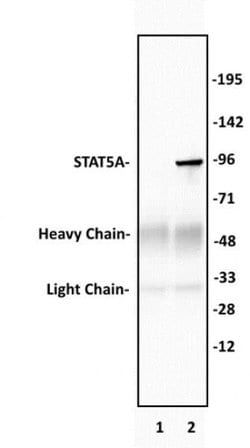
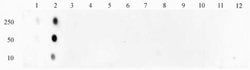
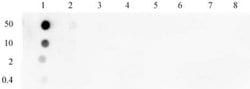
Dot Blot, Western Blot
Conjugate
Unconjugated
Host Species
Rabbit
Target Species
Human
Gene Accession No.
P42229, P51692
Gene ID (Entrez)
6776, 6777
Immunogen
This STAT5A/B phospho Ser726/Ser731 antibody was raised against a peptide containing phospho Ser726 of human STAT5A. Human STAT5B shares the identical sequence surrounding Ser731.
Primary or Secondary
Primary
Content And Storage
-20°C, Avoid Freeze/Thaw Cycles
Gene
STAT5B
Concentration
Lot-Specific
Classification
Polyclonal
Form
Liquid
Regulatory Status
RUO
Formulation
70mM tris with 0.07mM EDTA, 105mM NaCl, 30% glycerol, 31mM glycine and 0.035% sodium azide; pH 8
Gene Alias
AA959963; Mammary gland factor; mammary gland factor STAT5A; mammary gland factor STAT5B; Mgf; Mpf; signal transducer and activator of transcription 5; Signal transducer and activator of transcription 5A; Signal transducer and activator of transcription 5B; STA5B; STAT; STAT5; Stat5a; STAT5B; transcription factor STAT5B
Gene Symbols
STAT5A, STAT5B
Isotype
IgG
Purification Method
Antigen affinity chromatography
Product Type
Antibody
Related Products

Description
- The protein encoded by this gene is a member of the STAT family of transcription factors
- In response to cytokines and growth factors, STAT family members are phosphorylated by the receptor-associated kinases, and then form homo- or heterodimers that translocate to the cell nucleus where they act as transcription activators
- This protein is activated by, and mediates the responses of, many cell ligands, such as IL-2, IL-3, IL-7, GM-CSF, erythropoietin, thrombopoietin, and different growth hormones
- Activation of this protein in myeloma and lymphoma associated with a TEL/JAK2 gene fusion is independent of cell stimulus and has been shown to be essential for the tumorigenesis
- The mouse counterpart of this gene is found to induce the expression of BCL2L1/ BCL-X(L), which suggests the antiapoptotic function of this gene in cells.