7188437
RING1 Polyclonal Antibody, Active Motif™
Rabbit Polyclonal Antibody
Manufacturer: Fischer Scientific
The price for this product is unavailable. Please request a quote
Antigen
RING1
Applications
Western Blot
Conjugate
Unconjugated
Host Species
Rabbit
Target Species
Human
Gene Accession No.
Q06587
Gene ID (Entrez)
6015
Immunogen
This antibody was raised against a peptide within the C-terminal region of human RING1.
Primary or Secondary
Primary
Content And Storage
-20°C, Avoid Freeze/Thaw Cycles
Gene
RING1
Concentration
Lot-Specific
Classification
Polyclonal
Form
Liquid
Regulatory Status
RUO
Formulation
PBS with 30% glycerol and 0.035% sodium azide; pH 7.5
Gene Alias
E3 ubiquitin-protein ligase RING1; Polycomb complex protein RING1; Really interesting new gene 1 protein; RING finger protein 1; Ring1; Ring1A; RING-type E3 ubiquitin transferase RING1; Rnf1; Transcription repressor Ring1A
Gene Symbols
RING1
Isotype
IgG
Purification Method
Antigen affinity chromatography
Product Type
Antibody
Related Products
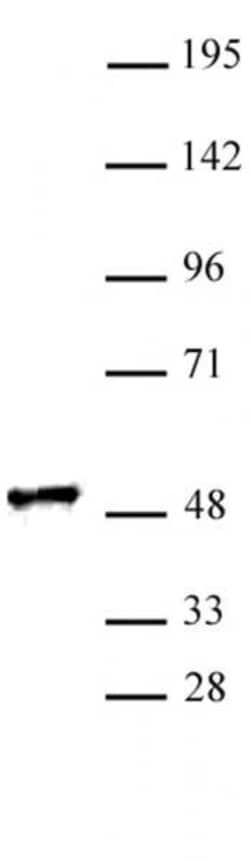
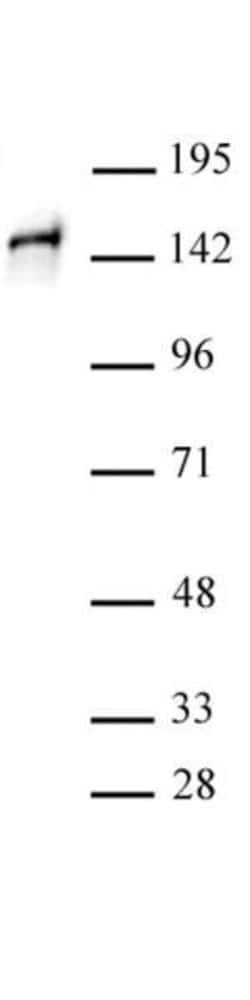

Description
- Description This gene belongs to the RING finger family, members of which encode proteins characterized by a RING domain, a zinc-binding motif related to the zinc finger domain
- The gene product can bind DNA and can act as a transcriptional repressor
- It is associated with the multimeric polycomb group protein complex
- The gene product interacts with the polycomb group proteins BMI1, EDR1, and CBX4, and colocalizes with these proteins in large nuclear domains
- It interacts with the CBX4 protein via its glycine-rich C-terminal domain
- The gene maps to the HLA class II region, where it is contiguous with the RING finger genes FABGL and HKE4.