7192898
Tmem119 Monoclonal Antibody (V3RT1GOsz), PerCP-eFluor™ 710, eBioscience™, Invitrogen™
Rat Monoclonal Antibody
Manufacturer: Fischer Scientific
The price for this product is unavailable. Please request a quote
Antigen
Tmem119
Concentration
0.2 mg/mL
Classification
Monoclonal
Form
Liquid
Regulatory Status
RUO
Formulation
PBS with 0.09% sodium azide; pH 7.2
Gene Alias
AW208946; BC025600; OBIF; Osteoblast induction factor; PSEC0199; Tmem119; Transmembrane protein 119; UNQ731/PRO1415
Gene Symbols
TMEM119
Isotype
IgG2a κ
Purification Method
Affinity chromatography
Product Type
Antibody
Clone
V3RT1GOsz
Applications
Flow Cytometry
Conjugate
PerCP-eFluor 710
Host Species
Rat
Target Species
Mouse
Gene Accession No.
Q8R138
Gene ID (Entrez)
231633
Immunogen
cell surface peptide
Primary or Secondary
Primary
Content And Storage
4° C, store in dark, DO NOT FREEZE!
Gene
TMEM119
Related Products

Description
- Tmem119 encodes a single-pass type I transmembrane protein which seems to interact with a multitude of micro-RNAs as well as certain transcription factors such as SMAD1, SMAD5 and RUNX2
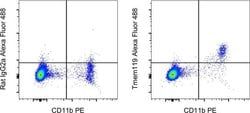
- Tmem119 has been identified as a surface marker of microglia that can be used to reliably distinguish microglia from infiltrating macrophages
- Microglial cells are phagocytes that are restricted to the brain and involved in clearing up debris and dendrite pruning of neurons
- They display a high functional plasticity, balancing neuroprotective and neurotoxic functions, which is reflected by their distinct physiology in response to changes in their microenvironment
- Microglia are particularly mobile in areas of the brain undergoing restructuring
- Reactive microglia co-express the marker Iba1
- In a pathological context, microglia have been associated with differentiation of pathogenic/inflammatory A1 type astrocytes by secretion of Cq1, IL-1a and TNF when stimulated with LPS, and thought to contribute to the pathology of several neurodegenerative diseases such as Alzheimers, Parkinsons, Chorea Huntingtons disease and Multiple Sclerosis
- The specific function Tmem119 plays on microglial cells remains unclear
- Outside of the neural system, Tmem119 seems to be involved in osteoblast differentiation/ossification.