LMO2 Recombinant Rabbit Monoclonal Antibody (9H9), Invitrogen™
Manufacturer: Thermo Scientific
Select a Size
| Pack Size | SKU | Availability | Price |
|---|---|---|---|
| Each of 1 | FEMA549991-Each-of-1 | In Stock | ₹ 37,202.00 |
FEMA549991 - Each of 1
In Stock
Quantity
1
Base Price: ₹ 37,202.00
GST (18%): ₹ 6,696.36
Total Price: ₹ 43,898.36
Antigen
LMO2
Classification
Recombinant Monoclonal
Concentration
0.38 mg/mL
Formulation
PBS with 50% glycerol and 0.02% sodium azide, pH 7.4
Gene Accession No.
P25791
Gene Symbols
Lmo2
Immunogen
A synthesized peptide derived from human LMO2
Quantity
100 μL
Primary or Secondary
Primary
Target Species
Human
Form
Liquid
Applications
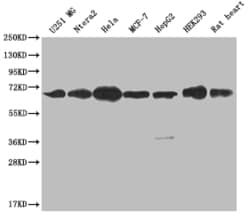
ELISA, Western Blot
Clone
9H9
Conjugate
Unconjugated
Gene
Lmo2
Gene Alias
cysteine-rich protein TTG-2, LIM domain only 2, LIM domain only 2 (rhombotin-like 1), LIM domain only protein 2, LIM domain only-2, LIM only 2, LMO2, LMO-2, LMO2 protein, Rbtn2, Rbtn-2, RBTNL1, RHOM2, Rhom-2, rhombotin 2, rhombotin-2, rhombotin-like 1, si:dkey-10o6.5, T-cell translocation gene 2, T-cell translocation protein 2, TTG2, wu:fc83a08, zgc:111930, zlmo2
Host Species
Rabbit
Purification Method
Affinity chromatography
Regulatory Status
RUO
Gene ID (Entrez)
4005
Content And Storage
-20°C or -80°C if preferred
Isotype
IgG
Related Products



Description
- LMO2 encodes a cysteine-rich, two LIM-domain protein that is required for yolk sac erythropoiesis
- The LMO2 protein has a central and crucial role in hematopoietic development and is highly conserved
- The LMO2 transcription start site is located approximately 25 kb downstream from the 11p13 T-cell translocation cluster (11p13 ttc), where a number T-cell acute lymphoblastic leukemia-specific translocations occur
- Alternative splicing results in multiple transcript variants encoding different isoforms.