LY6G6D Recombinant Human Monoclonal Antibody (8I8), Invitrogen™
Manufacturer: Thermo Scientific
Select a Size
| Pack Size | SKU | Availability | Price |
|---|---|---|---|
| Each of 1 | FEMA550088-Each-of-1 | In Stock | ₹ 37,202.00 |
FEMA550088 - Each of 1
In Stock
Quantity
1
Base Price: ₹ 37,202.00
GST (18%): ₹ 6,696.36
Total Price: ₹ 43,898.36
Antigen
LY6G6D
Classification
Recombinant Monoclonal
Concentration
1 mg/mL
Formulation
PBS with 50% glycerol and 0.03% Proclin 300, pH 7.4
Gene Accession No.
O95868
Gene Symbols
LOC102119090, LY6G6D
Immunogen
Recombinant Human LY6G6D protein
Quantity
100 μL
Primary or Secondary
Primary
Target Species
Human, Non-human Primate
Form
Liquid
Applications
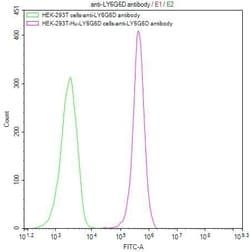
ELISA, Flow Cytometry, Neutralization
Clone
8I8
Conjugate
Unconjugated
Gene
LY6G6D
Gene Alias
C6orf23, DADB-110M10.6, G6D, LY6-D, LY6G6D, Lymphocyte antigen 6 complex locus protein G6d, lymphocyte antigen 6 complex, locus G6D, lymphocyte antigen 6 family member G6D, lymphocyte antigen-6 G6D, megakaryocyte-enhanced gene transcript 1 protein, MEGT1, NG25, Protein Ly6-D
Host Species
Human
Purification Method
Affinity chromatography
Regulatory Status
RUO
Gene ID (Entrez)
102119090, 58530
Content And Storage
-20°C or -80°C if preferred
Isotype
IgG1
Related Products

Description
- G6D, also known as Lymphocyte antigen 6 complex locus G6D (LY6G6D), is a type I transmembrane protein belonging to the immunoglobin (Ig) superfamily, that is comprised of cell-surface proteins involved in the immune system and cellular recognition
- It is a disulfide linked homodimer with an Ig-like V-type domain and is known to interact with GRB2 and GRB7 in a phosphorylation-dependent manner thus playing an important role in their downstream signal transduction pathways.