Phospho-MAX (Ser11) Polyclonal Antibody, Invitrogen™
Manufacturer: Thermo Scientific
Select a Size
| Pack Size | SKU | Availability | Price |
|---|---|---|---|
| Each of 1 | PA540187-Each-of-1 | In Stock | ₹ 46,502.50 |
PA540187 - Each of 1
In Stock
Quantity
1
Base Price: ₹ 46,502.50
GST (18%): ₹ 8,370.45
Total Price: ₹ 54,872.95
Antigen
Phospho-MAX (Ser11)
Classification
Polyclonal
Conjugate
Unconjugated
Gene
MAX
Gene Alias
AA960152; AI875693; bHLHd4; bHLHd5; bHLHd6; bHLHd7; bHLHd8; Class D basic helix-loop-helix protein 4; Delta-Max; Max; Max protein; MGC10775; MGC11225; MGC18164; MGC34679; MGC36767; MYC associated factor X; myc-associated factor X; Myc-binding novel HLH/LZ protein; Myn; orf1; Protein max; protein myn
Host Species
Rabbit
Purification Method
Antigen affinity chromatography
Regulatory Status
RUO
Gene ID (Entrez)
4149
Content And Storage
-20° C, Avoid Freeze/Thaw Cycles
Form
Liquid
Applications
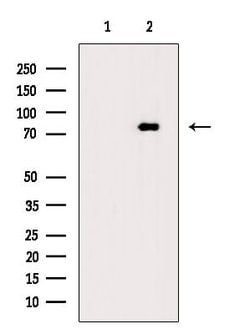
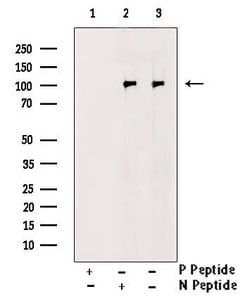
Western Blot
Concentration
1 mg/mL
Formulation
PBS with 50% glycerol and 0.02% sodium azide; pH 7.3
Gene Accession No.
P61244
Gene Symbols
MAX
Immunogen
Synthesized peptide derived from human MAX around phosphorylation site of S11.
Quantity
100 μL
Primary or Secondary
Primary
Target Species
Human
Product Type
Antibody
Isotype
IgG
Related Products

Description
- The protein encoded by this gene is a member of the basic helix-loop-helix leucine zipper (bHLHZ) family of transcription factors
- It is able to form homodimers and heterodimers with other family members, which include Mad, Mxi1 and Myc
- Myc is an oncoprotein implicated in cell proliferation, differentiation and apoptosis
- The homodimers and heterodimers compete for a common DNA target site (the E box) and rearrangement among these dimer forms provides a complex system of transcriptional regulation
- Multiple alternatively spliced transcript variants have been described for this gene but the full-length nature for some of them is unknown.