PA549745
ITGB5 Polyclonal Antibody, Invitrogen™
Manufacturer: Thermo Scientific
Select a Size
| Pack Size | SKU | Availability | Price |
|---|---|---|---|
| Each of 1 | PA549745-Each-of-1 | In Stock | ₹ 52,510.00 |
PA549745 - Each of 1
In Stock
Quantity
1
Base Price: ₹ 52,510.00
GST (18%): ₹ 9,451.80
Total Price: ₹ 61,961.80
Antigen
ITGB5
Classification
Polyclonal
Conjugate
Unconjugated
Gene
Itgb5
Gene Alias
[b]5; [b]-5; [b]5A; [b]5B; AA475909; AI874634; beta5; beta-5; CD61; ESTM23; FLJ26658; GP3A; GPIIIa; I79_000655; integrin beta 5; integrin beta-5; integrin subunit beta 5; integrin, beta 5; ITGB5; RGD1563276; testis secretory sperm-binding protein Li 217p
Host Species
Rabbit
Purification Method
Antigen affinity chromatography
Regulatory Status
RUO
Gene ID (Entrez)
16419, 257645, 3693
Content And Storage
-20°C
Form
Liquid
Applications
Western Blot
Concentration
1 mg/mL
Formulation
PBS with 50% glycerol and 0.02% sodium azide; pH 7.4
Gene Accession No.
O70309, P18084
Gene Symbols
Itgb5
Immunogen
Synthesized peptide derived from human Integrin beta5.
Quantity
100 μL
Primary or Secondary
Primary
Target Species
Human, Mouse, Rat
Product Type
Antibody
Isotype
IgG
Related Products


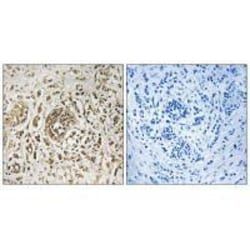




Description
- The antibody detects endogenous levels of total Integrin beta 5 protein
- Integrins are important extracellular matrix (ECM) receptor proteins located on cell surfaces
- They are hetrodimers composed of an alpha and a beta transmembrane glycoprotein subunit
- Around 22 different integrins (different alpha/ beta subunit combinations) are found in nature
- Integrins are generally present in high concentrations at the cell surface, but, unlike most other cell-surface receptors, they bind ligands with very low affinity
- Due to their weak individual binding, integrins need to cluster and bind in-groups in order to effectively bind the ECM
- Integrins bind many different ligands including laminin
- Each integrin is made up of a large N-terminal extracellular domain that binds the ECM ligand and a small C-terminal cytoplasmic domain that mediates interaction with the actin cytoskeleton and signaling function.