ASB2 Polyclonal Antibody, Invitrogen™
Manufacturer: Thermo Scientific
Select a Size
| Pack Size | SKU | Availability | Price |
|---|---|---|---|
| Each of 1 | PA550361-Each-of-1 | In Stock | ₹ 48,104.50 |
PA550361 - Each of 1
In Stock
Quantity
1
Base Price: ₹ 48,104.50
GST (18%): ₹ 8,658.81
Total Price: ₹ 56,763.31
Antigen
ASB2
Classification
Polyclonal
Conjugate
Unconjugated
Gene
ASB2
Gene Alias
1110008E15Rik; ankyrin repeat and SOCS box containing 2; ankyrin repeat and SOCS box protein 2; ankyrin repeat and SOCS box-containing 2; ankyrin repeat and SOCS box-containing protein 2; ankyrin repeat and SOCS box-containing protein 2a; ankyrin repeat-containing SOCS box protein 2; Asb2; ASB-2; asb2 {ECO:0000312; EMBL:AAH85882.1}; MGC40044
Host Species
Rabbit
Purification Method
Antigen affinity chromatography
Regulatory Status
RUO
Gene ID (Entrez)
51676
Content And Storage
-20°C
Form
Liquid
Applications
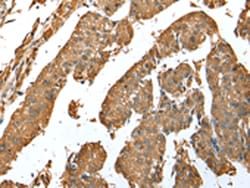
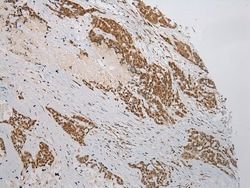
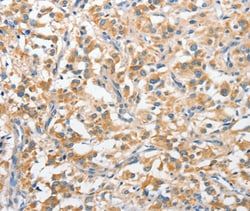
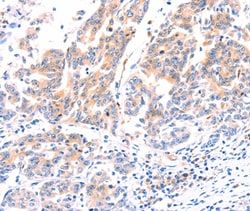
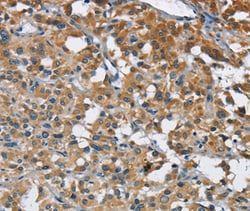
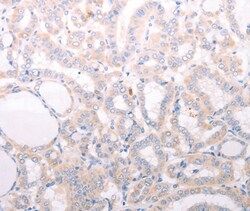
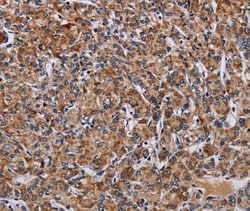
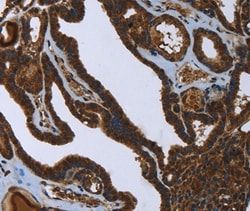
Immunohistochemistry (Paraffin)
Concentration
2.3 mg/mL
Formulation
PBS with 40% glycerol and 0.05% sodium azide; pH 7.4
Gene Accession No.
Q96Q27
Gene Symbols
ASB2
Immunogen
Fusion protein corresponding to a region derived from internal residues of human ankyrin repeat and SOCS box containing 2
Quantity
100 μL
Primary or Secondary
Primary
Target Species
Human
Product Type
Antibody
Isotype
IgG
Related Products
Description
- The antibody detects endogenous levels of total ASB2 protein
- The protein encoded by this gene is a member of the ankyrin repeat and SOCS box-containing (ASB) family of proteins
- They contain ankyrin repeat sequence and SOCS box domain
- The SOCS box serves to couple suppressor of cytokine signalling (SOCS) proteins and their binding partners with the elongin B and C complex, possibly targeting them for degradation
- This gene is induced by all-trans retinoic acid
- In myeloid leukemia cells, the expression of this encoded protein has been shown to induce growth inhibition and chromatin condensation
- Multiple alternatively spliced transcript variants have been described for this gene but their full length sequences are not known.