RBMS3 Polyclonal Antibody, Invitrogen™
Manufacturer: Thermo Scientific
Select a Size
| Pack Size | SKU | Availability | Price |
|---|---|---|---|
| Each of 1 | PA550524-Each-of-1 | In Stock | ₹ 47,036.50 |
PA550524 - Each of 1
In Stock
Quantity
1
Base Price: ₹ 47,036.50
GST (18%): ₹ 8,466.57
Total Price: ₹ 55,503.07
Antigen
RBMS3
Classification
Polyclonal
Conjugate
Unconjugated
Gene
RBMS3
Gene Alias
6720477E09Rik; 8430436O14Rik; RBMS3; RNA binding motif single stranded interacting protein 3; RNA binding motif, single stranded interacting protein; RNA binding motif, single stranded interacting protein 3; RNA-binding motif, single-stranded-interacting protein 3; RNA-binding protein; RNA-binding protein RBMS3
Host Species
Rabbit
Purification Method
Antigen affinity chromatography
Regulatory Status
RUO
Gene ID (Entrez)
27303
Content And Storage
-20°C
Form
Liquid
Applications
Immunohistochemistry (Paraffin), Western Blot
Concentration
0.9 mg/mL
Formulation
PBS with 40% glycerol and 0.05% sodium azide; pH 7.4
Gene Accession No.
Q6XE24
Gene Symbols
RBMS3
Immunogen
Synthetic peptide corresponding to residues near the C terminal of human RNA binding motif, single stranded interacting protein 3
Quantity
100 μL
Primary or Secondary
Primary
Target Species
Human
Product Type
Antibody
Isotype
IgG
Related Products

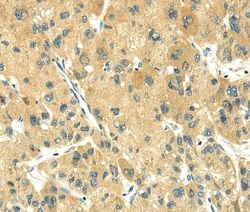
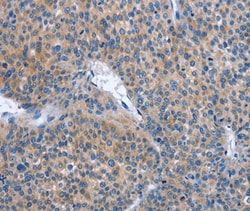
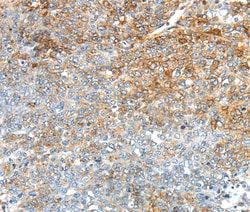

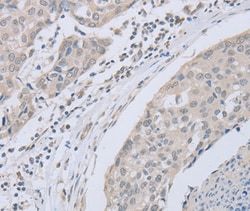

Description
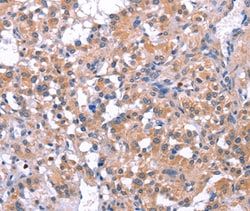
- The antibody detects endogenous levels of total RBMS3 protein
- This gene encodes an RNA-binding protein that belongs to the c-myc gene single-strand binding protein family
- These proteins are characterized by the presence of two sets of ribonucleoprotein consensus sequence (RNP-CS) that contain conserved motifs, RNP1 and RNP2, originally described in RNA binding proteins, and required for DNA binding
- These proteins have been implicated in such diverse functions as DNA replication, gene transcription, cell cycle progression and apoptosis
- The encoded protein was isolated by virtue of its binding to an upstream element of the alpha2(I) collagen promoter
- The observation that this protein localizes mostly in the cytoplasm suggests that it may be involved in a cytoplasmic function such as controlling RNA metabolism, rather than transcription
- Multiple alternatively spliced transcript variants encoding different isoforms have been found for this gene.