Phospho-SMAD1/SMAD5 (Ser463, Ser465) Recombinant Rabbit Monoclonal Antibody (31H14L11), Invitrogen™
Manufacturer: Thermo Scientific
Select a Size
| Pack Size | SKU | Availability | Price |
|---|---|---|---|
| Each of 1 | PI700047-Each-of-1 | In Stock | ₹ 51,798.00 |
PI700047 - Each of 1
In Stock
Quantity
1
Base Price: ₹ 51,798.00
GST (18%): ₹ 9,323.64
Total Price: ₹ 61,121.64
Antigen
Phospho-SMAD1/SMAD5 (Ser463, Ser465)
Classification
Recombinant Monoclonal
Concentration
0.5 mg/mL
Formulation
PBS with 0.09% sodium azide
Gene Accession No.
Q15797, Q99717
Gene Symbols
SMAD1, Smad5
Immunogen
A peptide corresponding to amino acids 456-465 of Q15797 and Q99717.
Quantity
100 μg
Primary or Secondary
Primary
Target Species
Human
Product Type
Antibody
Isotype
IgG
Applications
Flow Cytometry, Immunocytochemistry, Immunohistochemistry (Paraffin), Western Blot
Clone
31H14L11
Conjugate
Unconjugated
Gene
SMAD1
Gene Alias
1110051M15Rik; AI451355; AI528653; BSP1; BSP-1; dwarfin-A; Dwarfin-C; dwf-A; DWFC; Dwf-C; hSMAD1; hSmad5; JV41; JV4-1; JV5-1; MAD (mothers against decapentaplegic, Drosophila) homolog 1; MAD homolog 1; MAD homolog 5; MAD homolog1 (mothers against decapentaplegic, Drosophila); MAD, mothers against decapentaplegic homolog 1; MAD, mothers against decapentaplegic homolog 5; Madh1; Madh5; Madr1; mad-related protein 1; Mlp1; mMad1; mothers against decapentaplegic homolog 1; Mothers against decapentaplegic homolog 5; mothers against decapentaplegic, drosophila, homolog of, 5; mothers against DPP homolog 1; mothers against DPP homolog 5; mothers-against-DPP-related 1; Msmad5; MusMLP; OTTHUMP00000223331; SMA- and MAD-related protein 5; SMAD; Smad 1; SMAD 5; SMAD family member 1; SMAD family member 5; SMAD, mothers against DPP homolog 1; SMAD, mothers against DPP homolog 5; SMAD1; SMAD5; TGF-beta signaling protein 1; transforming growth factor-beta signaling protein 1; Transforming growth factor-beta-signaling protein 1
Host Species
Rabbit
Purification Method
Protein A
Regulatory Status
RUO
Gene ID (Entrez)
4086, 4090
Content And Storage
Store at 4°C short term. For long term storage, store at -20°C, avoiding freeze/thaw cycles.
Form
Liquid
Related Products
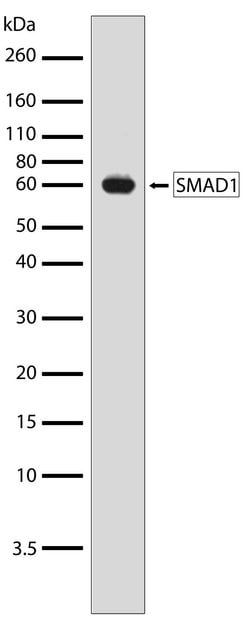
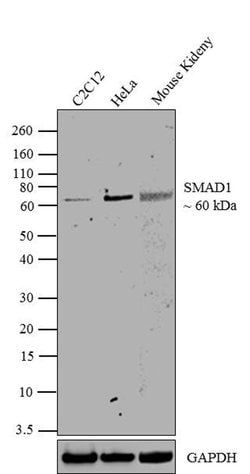
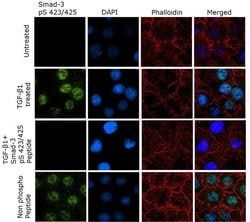
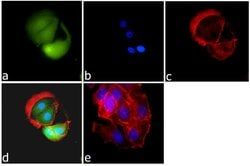

Description
- This antibody is predicted to react with mouse, primate, rat, Rhesus monkey , sea urchin, ovine, porcine, Xenopus and zebrafish based on sequence homology
- Intact IgG appears on a non-reducing gel as ∽150 kDa band and upon reduction generating a ∽25 kDa light chain band and a ∽50 kDa heavy chain
- Recombinant rabbit monoclonal antibodies are produced using in vitro expression systems
- The expression systems are developed by cloning in the specific antibody DNA sequences from immunoreactive rabbits
- Then, individual clones are screened to select the best candidates for production
- The advantages of using recombinant rabbit monoclonal antibodies include: better specificity and sensitivity, lot-to-lot consistency, animal origin-free formulations, and broader immunoreactivity to diverse targets due to larger rabbit immune repertoire
- The Smad family of proteins are functioning in the transmission of extracellular signals in the TGF-beta signaling pathway
- Binding of a TGF-beta superfamily ligands to extracellular receptors triggers phosphorylation of Smad2 at a Serine-Serine-Methionine-Serine (SSMS) motif at its C-terminus
- Phosphorylated Smad2 is then able to form a complex with Smad4
- These complexes accumulate in the cell nucleus, where they are directly participating in the regulation of gene expression
- In mammals, eight Smad proteins have been identified to date
- The Smad family of proteins can be divided into three functional groups: the receptor-activated Smads (R-Smads), common mediator Smads (Co-Smads), and the inhibitory Smads (I-Smads)
- The R-Smads are directly phosphorylated by the activated type I receptors on their C-terminal Ser-Ser-X-Ser (SSXS) motif and include Smad1, Smad2, Smad3, Smad5, and Smad8
- Smad2 and Smad3 are phosphorylated in response to TGF-beta and activin, whereas Smad1, Smad5, and Smad8 are phosphorylated in response to BMP (Bone Morphogenetic Protein)
- This C-terminal phosphorylation allows R-Smad binding to Co-Smad, Smad4, and translocation to the nucleus where they regulate TGF-beta target genes
- Smad6 and Smad7 belong to the I-Smad which bind to the type I receptor or Smad4 and block their interaction with R-Smads.