CD151 Monoclonal Antibody (11G5a), FITC, Invitrogen™
Manufacturer: Thermo Scientific
Select a Size
| Pack Size | SKU | Availability | Price |
|---|---|---|---|
| Each of 1 | PIMA181266-Each-of-1 | In Stock | ₹ 57,093.50 |
PIMA181266 - Each of 1
In Stock
Quantity
1
Base Price: ₹ 57,093.50
GST (18%): ₹ 10,276.83
Total Price: ₹ 67,370.33
Antigen
CD151
Classification
Monoclonal
Concentration
0.1 mg/mL
Formulation
PBS with 1% BSA and 0.09% sodium azide
Gene Accession No.
P48509
Gene Symbols
CD151
Immunogen
Proprietary Immunogen.
Quantity
100 μg
Primary or Secondary
Primary
Target Species
Human
Product Type
Antibody
Isotype
IgG1
Applications
Flow Cytometry
Clone
11G5a
Conjugate
FITC
Gene
CD151
Gene Alias
CD 151; CD151; CD151 antigen; CD151 antigen (Raph blood group); CD151 molecule; CD151 molecule (Raph blood group); GP27; hemidesmosomal tetraspanin CD151; membrane glycoprotein SFA-1; MER2; Peta3; PETA-3; platelet endothelial tetraspan antigen-3; platelet surface glycoprotein gp27; platelet-endothelial cell tetraspan antigen 3; platelet-endothelial tetraspan antigen 3; RAPH; SFA1; SFA-1; Tetraspanin-24; TSPAN24; tspan-24
Host Species
Mouse
Purification Method
Protein A
Regulatory Status
RUO
Gene ID (Entrez)
977
Content And Storage
Store at 4°C short term. For long term storage, store at -20°C, avoiding freeze/thaw cycles. Store in the dark.
Form
Liquid
Related Products


Description
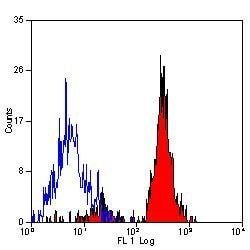
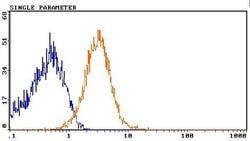
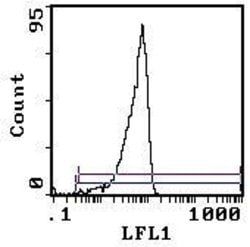
- For FACS analysis, use 10 μL of the suggested working dilution to label 1x10^6 cells in 100 μL
- Mouse anti Human CD151 antibody, clone 11G5a recognizes the human CD151 cell surface antigen, also known as PETA-3
- CD151 is expressed by epithelial cells, endothelial cells, platelets, megakaryocytes, monocytes and in the renal glomeruli and proximal and distal tubules
- The protein encoded by this gene is a member of the transmembrane 4 superfamily, also known as the tetraspanin family
- Most of these members are cell-surface proteins that are characterized by the presence of four hydrophobic domains
- The proteins mediate signal transduction events that play a role in the regulation of cell development, activation, growth and motility
- This encoded protein is a cell surface glycoprotein that is known to complex with integrins and other transmembrane 4 superfamily proteins
- It is involved in cellular processes including cell adhesion and may regulate integrin trafficking and/or function
- This protein enhances cell motility, invasion and metastasis of cancer cells
- Multiple alternatively spliced transcript variants that encode the same protein have been described for this gene.