HSP90 alpha Monoclonal Antibody (3G3), Invitrogen™
Manufacturer: Thermo Scientific
Select a Size
| Pack Size | SKU | Availability | Price |
|---|---|---|---|
| Each of 1 | PIMA3011-Each-of-1 | In Stock | ₹ 35,956.00 |
PIMA3011 - Each of 1
In Stock
Quantity
1
Base Price: ₹ 35,956.00
GST (18%): ₹ 6,472.08
Total Price: ₹ 42,428.08
Antigen
HSP90 alpha
Classification
Monoclonal
Concentration
Conc. Not Determined
Formulation
ascites with Ammonium sulfate and no preservative
Gene Accession No.
P07900, P07901, P11501, P82995
Gene Symbols
Hsp90aa1
Immunogen
Purified mouse HSP90.
Regulatory Status
RUO
Gene ID (Entrez)
15519, 299331, 3320, 423463
Content And Storage
-20° C, Avoid Freeze/Thaw Cycles
Form
Liquid
Applications
Immunocytochemistry, Immunohistochemistry, Immunoprecipitation, Western Blot
Clone
3G3
Conjugate
Unconjugated
Gene
Hsp90aa1
Gene Alias
86kDa; 89kDa; 90-kDa heat shock protein; 90-kDa heat shock protein alpha; akineto; AL024080; AL024147; EL52; epididymis luminal secretory protein 52; epididymis secretory sperm binding protein Li 65p; fb17b01; heat shock 86 kDa; heat shock 90kD protein 1, alpha; heat shock 90kD protein 1, alpha-like 4; heat shock 90kD protein, alpha-like 4; heat shock 90kDa protein 1, alpha; heat shock 90kDa protein 1, beta; Heat shock protein; heat shock protein 1, alpha; heat shock protein 86; heat shock protein 90; heat shock protein 90 alpha family class A member 1; heat shock protein 90, alpha (cytosolic), class A member 1; heat shock protein 90, alpha (cytosolic), class A member 1, tandem duplicate 1; heat shock protein 90-alpha 1; heat shock protein 90kDa alpha (cytosolic), class A member 1; heat shock protein 90kDa alpha family class A member 1; heat shock protein alpha; Heat shock protein HSP 90-alpha; Heat shock protein HSP 90-alpha 1; heat shock protein HSP90 alpha; heat shock protein hsp90a
Host Species
Mouse
Quantity
400 μL
Primary or Secondary
Primary
Target Species
Chicken, Fish, Human, Mouse, Non-human Primate, Rat
Product Type
Antibody
Isotype
IgM
Related Products

Description
- MA3-011 detects heat shock protein 90 kDa (HSP90) from human, mouse, rat, rainbow trout, and chicken tissues
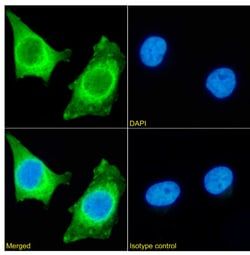
- MA3-011 has been successfully used in Western blot, immunofluorescence, immunohistochemistry, and immunoprecipitation procedures
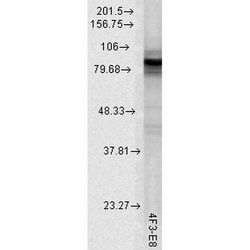
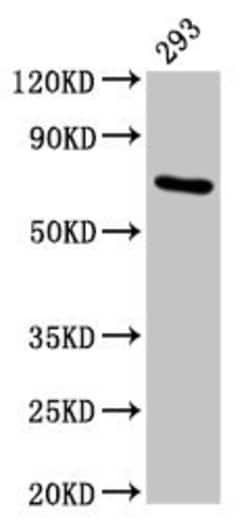
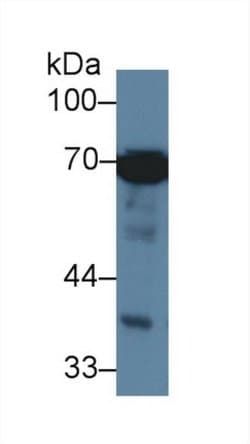
- By Western blot, this antibody detects a 90 kDa protein representing HSP90 from Hepa 1 cell extract
- It has been reported that up to 90% of cytosolic HSP90 can be immunoprecipitated with this product under low ionic strength conditions
- For Western blots using MA3-011, nitrocellulose is recommended
- PVDF membranes typically do not yield acceptable results with this antibody
- Before use, centrifuge suspension (4000 g for 15 minutes) and discard supernatant
- Resuspend pellet in 200 μL of PBS, pH 7.2
- If desired, 0.05% sodium azide may be added to resuspended solution
- Removal of residual ammonium sulfate is not usually necessary for immunoprecipitation and Western blot procedures, however, any other uses may require its removal by dialysis or equivalent method
- Stable for 6 months after PBS resuspension
- The MA3-011 antigen is purified HSP90 from Hepa 1 cytosol
- Heat shock proteins (HSP) are proteins that are expressed in response to various biological stress, including heat
- HSP90 is a 90 kDa protein that is induced under stress conditions, but is also one of the most abundant cellular proteins found under non-stress conditions
- HSP90 has been found to be associated with a number of other intracellular proteins, including steroid receptors, actin, tubulin, and some kinases
- It has been suggested that HSP90 is necessary to maintain structural integrity of at least some steroid receptors to allow for ligand binding during receptor activation.