PIMA511955
Prolactin Receptor Monoclonal Antibody (B6.2), Invitrogen™
Manufacturer: Thermo Scientific
Select a Size
| Pack Size | SKU | Availability | Price |
|---|---|---|---|
| Each of 1 | PIMA511955-Each-of-1 | In Stock | ₹ 46,947.50 |
PIMA511955 - Each of 1
In Stock
Quantity
1
Base Price: ₹ 46,947.50
GST (18%): ₹ 8,450.55
Total Price: ₹ 55,398.05
Antigen
Prolactin Receptor
Classification
Monoclonal
Concentration
0.2 mg/mL
Formulation
PBS with 0.2% BSA and 0.09% sodium azide; pH 7.4
Gene Accession No.
P16471
Gene Symbols
PRLR
Immunogen
Semi-purified human prolactin receptor
Quantity
500 μL
Primary or Secondary
Primary
Target Species
Human
Product Type
Antibody
Isotype
IgG1
Applications
Immunohistochemistry (Paraffin)
Clone
B6.2
Conjugate
Unconjugated
Gene
PRLR
Gene Alias
AI987712; cytokine receptor; HPRL; hPRL receptor; hPRLrI; Lactogen receptor; MFAB; pPRLR-SF; Pr-1; Pr-3; Prl R; PRLR; PRL-R; Prlr-rs1; Prolactin receptor; prolactin receptor 2 precursor; prolactin receptor related sequence 1; prolactin receptor short isoform; RATPRLR; secreted prolactin binding protein
Host Species
Mouse
Purification Method
Protein G
Regulatory Status
RUO
Gene ID (Entrez)
5618
Content And Storage
4° C
Form
Liquid
Related Products

Description
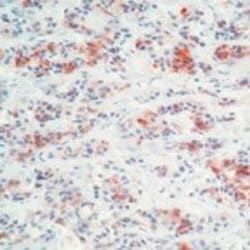
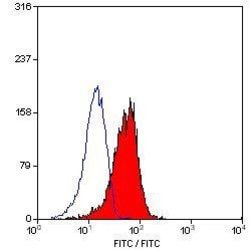
- MA5-11955 targets Prolactin Receptor in IHC (P) applications and shows reactivity with Human samples
- The MA5-11955 immunogen is semi-purified human prolactin receptor
- Prolactin (PRL) is a pituitary hormone involved in the stimulation of milk production, salt and water regulation, growth, development and reproduction
- PRL exerts its influence on different cell types through a signal transduction pathway which begins with the binding of the hormone to a transmembrane PRL receptor
- Immunoreactive PRL receptor (PRLR), a member of the cytokine receptor family, varies in size (short and long forms) with tissue source and species, from ∽40 kDa to 100 kDa
- PRLR consists of at least three separate domains: an extracellular region with 5 cysteines which contains the prolactin binding site, a single transmembrane domain and a cytoplasmic region, the length of which appears to influence ligand binding and regulate cellular function.