PIMA516407
UPK3A Monoclonal Antibody (SP73), Invitrogen™
Manufacturer: Thermo Scientific
Select a Size
| Pack Size | SKU | Availability | Price |
|---|---|---|---|
| Each of 1 | PIMA516407-Each-of-1 | In Stock | ₹ 63,190.00 |
PIMA516407 - Each of 1
In Stock
Quantity
1
Base Price: ₹ 63,190.00
GST (18%): ₹ 11,374.20
Total Price: ₹ 74,564.20
Antigen
UPK3A
Classification
Monoclonal
Conjugate
Unconjugated
Gene
Upk3a
Gene Alias
1110017C07Rik; proplakin IIIa; UP3a; UPIII; UPIIIA; Upk3; UPK3A; uroplakin 3; uroplakin 3A; uroplakin III; Uroplakin-3a
Host Species
Rabbit
Purification Method
Protein A/G
Regulatory Status
RUO
Gene ID (Entrez)
7380
Content And Storage
Store at 4°C short term. For long term storage, store at -20°C, avoiding freeze/thaw cycles.
Form
Liquid
Applications
Immunohistochemistry (Paraffin)
Clone
SP73
Formulation
PBS with 1% BSA and 0.1% sodium azide; pH 7.6
Gene Accession No.
O75631
Gene Symbols
Upk3a
Immunogen
Synthetic peptide corresponding to C-terminus of human uroplakin III protein.
Quantity
500 μL
Primary or Secondary
Primary
Target Species
Human
Product Type
Antibody
Isotype
IgG
Related Products
Description
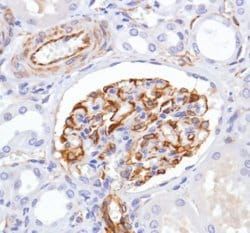
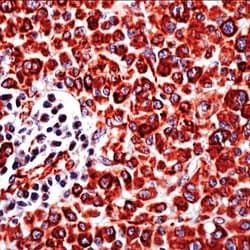
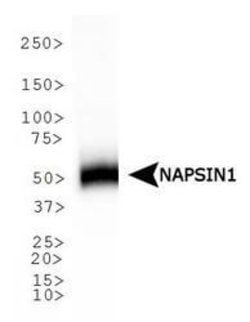
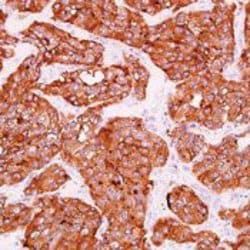
- Heat-mediated antigen retrieval is recommended prior to staining, using a 10mM citrate buffer, pH 6.0, for 10 minutes followed by cooling at room temperature for 20 min
- Following antigen retrieval, incubate samples with primary antibody for 30 min at room temperature
- A suggested positive control is bladder carcinoma
- This gene encodes a member of the uroplakin family, a group of transmembrane proteins that form complexes on the apical surface of the bladder epithelium
- Mutations in this gene may be associated with renal adysplasia
- Alternatively spliced transcript variants have been described.