PHLDA1 Monoclonal Antibody (OTI4D9), Invitrogen™
Manufacturer: Thermo Scientific
Select a Size
| Pack Size | SKU | Availability | Price |
|---|---|---|---|
| Each of 1 | PIMA527376-Each-of-1 | In Stock | ₹ 52,198.50 |
PIMA527376 - Each of 1
In Stock
Quantity
1
Base Price: ₹ 52,198.50
GST (18%): ₹ 9,395.73
Total Price: ₹ 61,594.23
Antigen
PHLDA1
Classification
Monoclonal
Concentration
1 mg/mL
Formulation
PBS with 1% BSA, 50% glycerol and 0.02% sodium azide; pH 7.3
Gene Accession No.
Q8WV24
Gene Symbols
PHLDA1
Immunogen
Human recombinant protein fragment corresponding to amino acids 183-401 of PHLDA1 produced in E.coli
Quantity
100μL
Primary or Secondary
Primary
Target Species
Human
Product Type
Antibody
Isotype
IgG1
Applications
Western Blot
Clone
OTI4D9
Conjugate
Unconjugated
Gene
PHLDA1
Gene Alias
apoptosis-associated nuclear protein; DT1P1B11; PHLDA1; PHRIP; pleckstrin homology like domain family A member 1; pleckstrin homology-like domain family A member 1; pleckstrin homology-like domain, family A, member 1; PQR protein; PQ-rich protein; proline- and glutamine-rich protein; Proline- and histidine-rich protein; proline-histidine rich protein; T-cell death associated; T-cell death-associated gene 51 protein; Tdag; TDAG51
Host Species
Mouse
Purification Method
Affinity Chromatography
Regulatory Status
RUO
Gene ID (Entrez)
22822
Content And Storage
-20° C, Avoid Freeze/Thaw Cycles
Form
Liquid
Related Products
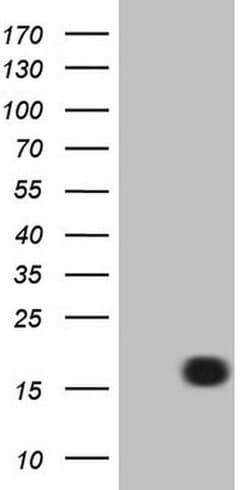
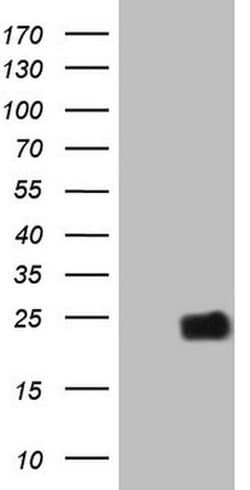
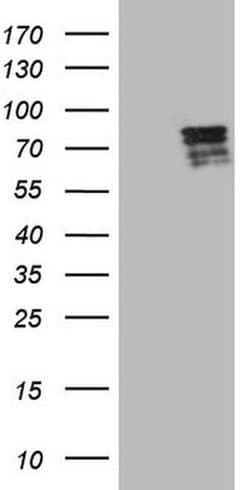
Description
- Cytotoxic T lymphocyte (CTL)-mediated cytotoxicity constitutes an important component of specific effector mechanisms in immunosurveillance against virus-infected or -transformed cells
- Two mechanisms appear to account for this activity, one of which is the perforin-based process
- Independently, a FAS-based mechanism involves the transducing molecule FAS (APO-1) and its ligand (FAS-L)
- The human FAS (APO-1) protein is a 48 kDa cell surface glycoprotein that belongs to a family of receptors that includes CD40, nerve growth factor receptors and tumor necrosis factor receptors
- The FAS antigen is expressed on a broad range of lymphoid cell lines, and is expressed at high levels in T cells subsequent to crosslinking of the T cell receptor (TCR)
- A previously undescribed protein, TDAG51, restores activation- induced apoptosis in cells that have lost the ability to display Fas in response to activation.