SULT1A1 Recombinant Rabbit Monoclonal Antibody (029), Invitrogen™
Manufacturer: Thermo Scientific
Select a Size
| Pack Size | SKU | Availability | Price |
|---|---|---|---|
| Each of 1 | PIMA530913-Each-of-1 | In Stock | ₹ 41,385.00 |
PIMA530913 - Each of 1
In Stock
Quantity
1
Base Price: ₹ 41,385.00
GST (18%): ₹ 7,449.30
Total Price: ₹ 48,834.30
Antigen
SULT1A1
Classification
Recombinant Monoclonal
Concentration
1 mg/mL
Formulation
PBS with no preservative
Gene Accession No.
P50225
Gene Symbols
SULT1A1
Immunogen
Recombinant Human SULT1A1 protein (Glu2-Leu295)
Quantity
100μL
Primary or Secondary
Primary
Target Species
Human
Product Type
Antibody
Isotype
IgG
Applications
ELISA
Clone
029
Conjugate
Unconjugated
Gene
SULT1A1
Gene Alias
AI266890; aryl sulfotransferase; Aryl sulfotransferase 1; Aryl sulfotransferase cytosolic 1A phenol-preferring member 3; Aryl sulfotransferase cytosolic, 1A, phenol-preferring, member 3; aryl sulfotransferase IV; arylsulfotransferase ST1A4; ASTIV; CSPS; HAST1/HAST2; MGC131921; MGC5163; Minoxidil sulfotransferase; mSTp1; Mx-ST; OK/SW-cl.88; OTTHUMP00000162568; OTTHUMP00000162569; P PST; P PST 1; Phenol sulfotransferase; Phenol sulfotransferase 1; Phenol sulfotransferase 1a1; phenol/aryl sulfotransferase; phenol-sulfating phenol sulfotransferase 1; P-PST; P-PST 1; PST; PST-1; St1a1; ST1A3; ST1A4; Stm; STP; STP1; sulfokinase; Sulfotransferase 1A1; sulfotransferase family 1A member 1; sulfotransferase family 1A, phenol-preferring, member 1; sulfotransferase family, cytosolic, 1A, phenol preferring; sulfotransferase family, cytosolic, 1A, phenol-preferring, member 1; sulfotransferase, phenol preferring 1; sulphotransferase family cytosolic 1A phenol-prefering member 1; SULT1A1; Sult1a3; Thermostable phenol sulfotransferase; thermostable phenol sulfotransferase1; ts-PST; TSPST1; Tyrosine-ester sulfotransferase
Host Species
Rabbit
Purification Method
Protein A
Regulatory Status
RUO
Gene ID (Entrez)
6817
Content And Storage
Store at 4°C short term. For long term storage, store at -20°C, avoiding freeze/thaw cycles.
Form
Liquid
Related Products

Description
- This product is preservative free
- It is recommended to add sodium azide to avoid contamination (final concentration 0.05%-0.1%)
- Recombinant rabbit monoclonal antibodies are produced using in vitro expression systems
- The expression systems are developed by cloning in the specific antibody DNA sequences from immunoreactive rabbits
- Then, individual clones are screened to select the best candidates for production
- The advantages of using recombinant rabbit monoclonal antibodies include: better specificity and sensitivity, lot-to-lot consistency, animal origin-free formulations, and broader immunoreactivity to diverse targets due to larger rabbit immune repertoire
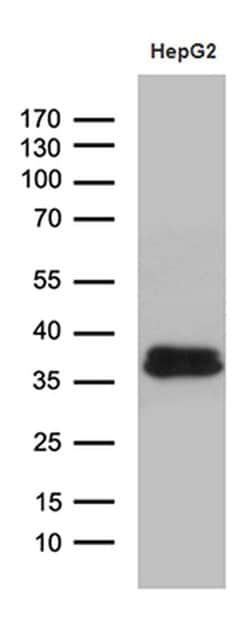
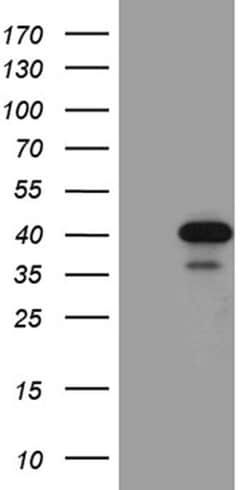
- This antibody has specificity for Human SULT1A1
- The soluble sulfotransferases contribute to the elimination of xenobiotics, the activation of procarcinogens and the regulation of hormones by catalyzing the sulfate conjugation of these substances
- Members of the three groups comprising this superfamily (namely SULT1, SULT2 and SULT3) show selectivity to certain substrate compounds
- SULT1A1 (sulfotransferase family, cytosolic, 1A, phenol-preferring, member 1), also known as STP or STP1, is a 295 amino acid protein that localizes to the cytoplasm and belongs to the sulfotransferase family
- Functioning as a homodimer that is expressed in brain, liver, skin and lung tissue, SULT1A1 catalyzes the sulfate conjugation of catecholamines, phenolic drugs and neurotransmitters and, via this catalytic activity, plays a role in the elimination of a variety of compounds from the body
- Additionally, SULT1A1 may be involved in the activation of carcinogenic N-hydroxyarylamines, indicating a possible role in carcinogenesis.