PIMA531729
Emerin Monoclonal Antibody (8F5G2), Invitrogen™
Manufacturer: Thermo Scientific
Select a Size
| Pack Size | SKU | Availability | Price |
|---|---|---|---|
| Each of 1 | PIMA531729-Each-of-1 | In Stock | ₹ 49,350.50 |
PIMA531729 - Each of 1
In Stock
Quantity
1
Base Price: ₹ 49,350.50
GST (18%): ₹ 8,883.09
Total Price: ₹ 58,233.59
Antigen
Emerin
Classification
Monoclonal
Concentration
1 mg/mL
Formulation
PBS with 0.05% sodium azide
Gene Accession No.
P50402
Gene Symbols
Emd
Immunogen
Purified recombinant fragment of human EMD (AA: 1-222) expressed in E. coli.
Quantity
100 μL
Primary or Secondary
Primary
Target Species
Human
Product Type
Antibody
Isotype
IgG1
Applications
ELISA, Flow Cytometry, Immunocytochemistry, Western Blot
Clone
8F5G2
Conjugate
Unconjugated
Gene
Emd
Gene Alias
AW550900; EDMD; EMD; Emerin; LEM domain containing 5; LEMD5; STA
Host Species
Mouse
Purification Method
Protein G
Regulatory Status
RUO
Gene ID (Entrez)
2010
Content And Storage
Store at 4°C short term. For long term storage, store at -20°C, avoiding freeze/thaw cycles.
Form
Liquid
Related Products


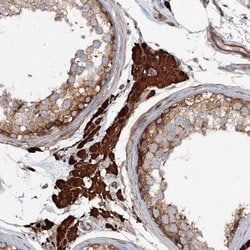


Description
- MA5-31729 has been tested in indirect ELISA
- Xeroderma pigmentosum type G (XPG) is a human genetic disease exhibiting extreme sensitivity to sunlight
- The XPG protein, a member of the flap endonuclease 1 (FEN-1) structure-specific DNA repair endonuclease family, is an enzyme essential for DNA repair of the major kinds of solar μgtraviolet (UV)-induced DNA damages
- Human XPG nuclease makes the 3' incision during nucleotide excision repair of DNA
- The enzyme cleaves model DNA bubble structures specifically near the junction of unpaired DNA with a duplex region
- A 29-amino acid region of human XPG (residues 981-1009) contains the PCNA binding activity
- A conserved arginine in XPG (Arg992) is crucial for its PCNA binding activity
- Replication Protein A (RPA) binds specifically and directly to two excision repair proteins, the xeroderma pigmentosum damage-recognition protein XPA and the endonuclease XPG.