TUBB1 Monoclonal Antibody (2A1A9), Invitrogen™
Manufacturer: Thermo Scientific
Select a Size
| Pack Size | SKU | Availability | Price |
|---|---|---|---|
| Each of 1 | PIMA531940-Each-of-1 | In Stock | ₹ 50,062.50 |
PIMA531940 - Each of 1
In Stock
Quantity
1
Base Price: ₹ 50,062.50
GST (18%): ₹ 9,011.25
Total Price: ₹ 59,073.75
Antigen
TUBB1
Classification
Monoclonal
Concentration
1 mg/mL
Formulation
PBS with 0.05% sodium azide
Gene Accession No.
A2AQ07, Q9H4B7
Gene Symbols
TUBB1
Immunogen
Purified recombinant fragment of human TUBB1 (AA: 33-166) expressed in E. coli.
Quantity
100 μL
Primary or Secondary
Primary
Target Species
Human, Mouse, Non-human Primate, Rat
Product Type
Antibody
Isotype
IgG1
Applications
ELISA, Flow Cytometry, Immunocytochemistry, Immunohistochemistry (Paraffin), Western Blot
Clone
2A1A9
Conjugate
Unconjugated
Gene
TUBB1
Gene Alias
2810484G07Rik; M(beta)1; tbb1; TUBB1; tubulin beta; tubulin beta 1 class VI; tubulin beta-1 chain; tubulin, beta 1 class VI
Host Species
Mouse
Purification Method
Protein G
Regulatory Status
RUO
Gene ID (Entrez)
545486, 679312, 81027
Content And Storage
Store at 4°C short term. For long term storage, store at -20°C, avoiding freeze/thaw cycles.
Form
Liquid
Related Products


Description
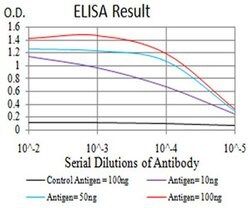
- MA5-31940 has been tested in indirect ELISA
- TUBB1 encodes a member of the beta tubulin protein family
- Beta tubulins are one of two core protein families (alpha and beta tubulins) that heterodimerize and assemble to form microtubules
- This protein is specifically expressed in platelets and megakaryocytes and may be involved in proplatelet production and platelet release
- A mutations in this gene is associated with autosomal dominant macrothrombocytopenia
- Two pseudogenes of this gene are found on chromosome Y.