SMAD5 Recombinant Rabbit Monoclonal Antibody (SI17-06), Invitrogen™
Manufacturer: Thermo Scientific
Select a Size
| Pack Size | SKU | Availability | Price |
|---|---|---|---|
| Each of 1 | PIMA532065-Each-of-1 | In Stock | ₹ 47,481.50 |
PIMA532065 - Each of 1
In Stock
Quantity
1
Base Price: ₹ 47,481.50
GST (18%): ₹ 8,546.67
Total Price: ₹ 56,028.17
Antigen
SMAD5
Classification
Monoclonal
Concentration
1 mg/mL
Formulation
TBS with 0.05% BSA, 40% Glycerol and 0.05% sodium azide, pH 7.4
Gene Accession No.
Q99717, Q9R1V3
Gene Symbols
SMAD5
Immunogen
Synthetic peptide within Human Smad5 aa 231-282
Quantity
100 μL
Primary or Secondary
Primary
Target Species
Human, Rat
Product Type
Antibody
Isotype
IgG
Applications
Flow Cytometry, Immunocytochemistry, Immunohistochemistry, Western Blot, Western Blot
Clone
SI17-06
Conjugate
Unconjugated
Gene
SMAD5
Gene Alias
1110051M15Rik, AI451355, DKFZp781C1895, DKFZp781O1323, dwarfin-C, DWFC, Dwf-C, hSmad5, JV5-1, MAD homolog 5, MAD, mothers against decapentaplegic homolog 5, Madh5, Mothers against decapentaplegic homolog 5, mothers against decapentaplegic, drosophila, homolog of, 5, mothers against DPP homolog 5, mSmad5, MusMLP, OTTHUMP00000223331, SMA- and MAD-related protein 5, SMAD, SMAD 5, SMAD family member 5, SMAD, mothers against DPP homolog 5, SMAD5
Host Species
Rabbit
Purification Method
Protein A
Regulatory Status
RUO
Gene ID (Entrez)
4090, 59328
Content And Storage
Store at 4°C short term. For long term storage, store at -20°C, avoiding freeze/thaw cycles.
Form
Liquid
Related Products
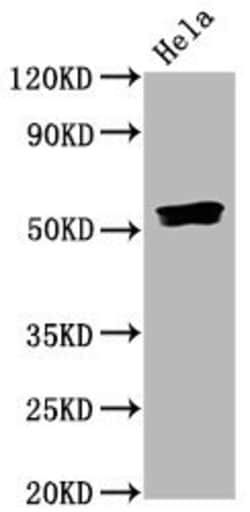
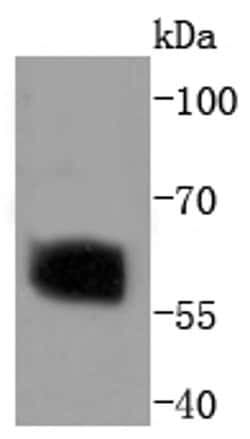

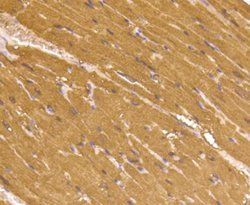
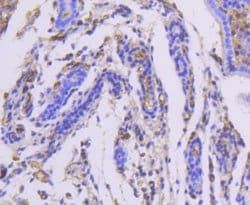
Description
- Recombinant rabbit monoclonal antibodies are produced using in vitro expression systems
- The expression systems are developed by cloning in the specific antibody DNA sequences from immunoreactive rabbits
- Then, individual clones are screened to select the best candidates for production
- The advantages of using recombinant rabbit monoclonal antibodies include: better specificity and sensitivity, lot-to-lot consistency, animal origin-free formulations, and broader immunoreactivity to diverse targets due to larger rabbit immune repertoire
- SMADs are members of the MAD-related family of molecules
- MAD-related proteins are a family of intracellular proteins that are essential components in the signaling pathways of the serine/threonine kinase receptors of the transforming growth factor beta superfamily
- SMADs can be divided into receptor-regulated SMADs (R-SMADs: SMAD1, 2, 5, 8 and 9), common-mediator SMAD (co-SMAD: SMAD4), and inhibitory SMADs (I-SMADs: SMAD6 and 7)
- SMAD1, 5, 8 and 9 have high degrees of homology and antibodies are available that recognize sequences common to all of them
- SMAD8 and SMAD9 are typically used as alternate names for one another in the literature.