H3K56ac Recombinant Rabbit Monoclonal Antibody (SU30-10), Invitrogen™
Manufacturer: Thermo Scientific
Select a Size
| Pack Size | SKU | Availability | Price |
|---|---|---|---|
| Each of 1 | PIMA532138-Each-of-1 | In Stock | ₹ 47,481.50 |
PIMA532138 - Each of 1
In Stock
Quantity
1
Base Price: ₹ 47,481.50
GST (18%): ₹ 8,546.67
Total Price: ₹ 56,028.17
Antigen
H3K56ac
Classification
Monoclonal
Concentration
1 mg/mL
Formulation
TBS with 0.05% BSA, 40% Glycerol and 0.05% sodium azide, pH 7.4
Gene Accession No.
P68431, P68433, P84228, Q71DI3
Gene Symbols
H3C1, H3C10, H3C12, H3C14, H3C15, H3C2, H3C7
Immunogen
Synthetic peptide within Human Histone H3 aa 31-80
Quantity
100 μL
Primary or Secondary
Primary
Target Species
Human, Mouse, Rat
Product Type
Antibody
Isotype
IgG
Applications
Immunocytochemistry, Immunohistochemistry, Western Blot, Western Blot
Clone
SU30-10
Conjugate
Unconjugated
Gene
H3C15
Gene Alias
Acetyl H3, Acetyl Histone H3, Acetyl-H3 K56, Acetyl-H3 Lys56, Acetyl-Histone H3 K56, Acetyl-Histone H3 Lys56, H3, H3 histone, H3 histone family, member A, H3 histone family, member I, H3 histone family, member K, H3 histone family, member L, H3 histone family, member M, H3 histone, family 2, H3 histone, family 3A, H3 histone, family 3B, H3 histone, family 3B (H3.3B), H3 histone, family 3C, H3 K56ac, H3.1-221, H3.1-291, H3.1-I, H3.2, H3.2-221, H3.2-614, H3.2-615, H3.2-616, H3.3A, H3.3B, H3.5, H3/A, H3/b, H3/d, H3/f, H3/i, H3/j, H3/k, H3/l, H3/M, H3/n, H3/o, H3-143, H3-291, H3-3A, H3-3b, H3-53, H3-614, H3a, H3b, H3-B, H3C1, H3C10, H3C11, H3C12, H3C2, H3C3, H3C4, H3C6, H3C7, H3C8, H3f, H3-F, H3F1K, H3F2, H3F3, H3F3A, H3f3b, H3F3C, H3FA, H3FB, H3FC HIST1H3C, H3FD, H3FF, H3FH, H3FI, H3FJ, H3FK, H3FL, H3FM, H3FN, H3g, H3h, H3i, H3K56, H3Lys56ac, Hist1, HIST1H3A, HIST1H3B, Hist1h3c, HIST1H3D, HIST1H3E, HIST1H3F, HIST1H3G, HIST1H3H, HIST1H3I, HIST1H3J, HIST2H3A, Hist2h3b, HIST2H3C, Hist2h3c1, Hist2h3c2, Hist2h3c2-ps, Hist2h3ca1, Hist2h3ca2, HIST2H3D, histone 1, H3a, histone 1, H3b, histone 1, H3f, histone 1, H3h, histone 2, H3a, histone 2, H3c, histone 2, H3c2, histone 2, H3ca2, Histone 3, histone cluster 1, H3a, histone cluster 1, H3b, histone cluster 1, H3f, histone cluster 1, H3h, histone cluster 2, H3a, histone cluster 2, H3c, histone cluster 2, H3c2, histone cluster 2, H3c2, pseudogene, histone gene complex 1, histone H3, histone H3.1, Histone H3.2, histone H3.3, Histone H3.3C, histone H3.5, Histone H3/a, Histone H3/b, Histone H3/c, Histone H3/d, Histone H3/f, Histone H3/h, Histone H3/i, Histone H3/j, Histone H3/k, histone H3/l, Histone H3/m, histone H3/o, Histone H3K56, histone variant H3.5, M32461, PP781
Host Species
Rabbit
Purification Method
Protein A
Regulatory Status
RUO
Gene ID (Entrez)
126961, 260423, 319150, 319152, 333932, 360198, 8350, 8356, 8357, 8358, 8968, 97114
Content And Storage
Store at 4°C short term. For long term storage, store at -20°C, avoiding freeze/thaw cycles.
Form
Liquid
Related Products

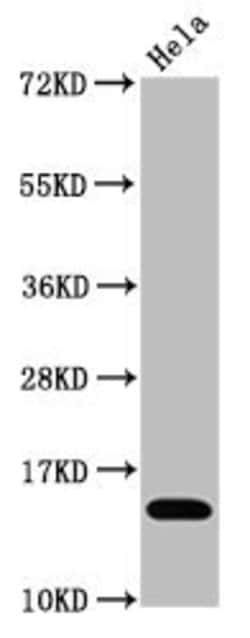
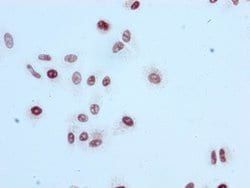
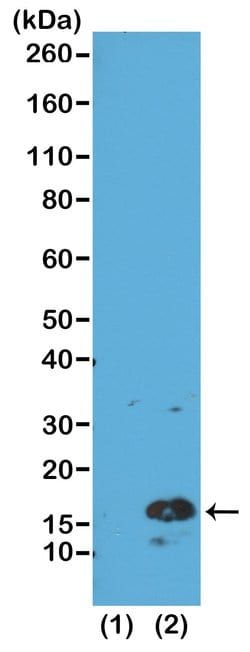
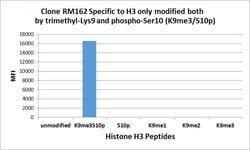
Description
- Recombinant rabbit monoclonal antibodies are produced using in vitro expression systems
- The expression systems are developed by cloning in the specific antibody DNA sequences from immunoreactive rabbits
- Then, individual clones are screened to select the best candidates for production
- The advantages of using recombinant rabbit monoclonal antibodies include: better specificity and sensitivity, lot-to-lot consistency, animal origin-free formulations, and broader immunoreactivity to diverse targets due to larger rabbit immune repertoire
- Histone H3 is one of the DNA-binding proteins found in the chromatin of all eukaryotic cells
- H3 along with four core histone proteins binds to DNA forming the structure of the nucleosome
- Histones play a central role in transcription regulation, DNA repair, DNA replication and chromosomal stability
- Post translationally, histones are modified in a variety of ways to either directly change the chromatin structure or allow for the binding of specific transcription factors
- The N-terminal tail of histone H3 protrudes from the globular nucleosome core and can undergo several different types of post-translational modification that influence cellular processes
- These modifications include the covalent attachment of methyl or acetyl groups to lysine and arginine amino acids and the phosphorylation of serine or threonine.