ATF5 Recombinant Rabbit Monoclonal Antibody (SD2099), Invitrogen™
Manufacturer: Thermo Scientific
Select a Size
| Pack Size | SKU | Availability | Price |
|---|---|---|---|
| Each of 1 | PIMA532365-Each-of-1 | In Stock | ₹ 46,413.50 |
PIMA532365 - Each of 1
In Stock
Quantity
1
Base Price: ₹ 46,413.50
GST (18%): ₹ 8,354.43
Total Price: ₹ 54,767.93
Antigen
ATF5
Classification
Monoclonal
Concentration
1 mg/mL
Formulation
TBS with 0.05% BSA, 40% Glycerol and 0.05% sodium azide, pH 7.4
Gene Accession No.
O70191, Q6P788, Q9Y2D1
Gene Symbols
Atf5
Immunogen
Synthetic peptide within Human ATF5 aa 203-252
Quantity
100 μL
Primary or Secondary
Primary
Target Species
Human, Mouse, Rat
Product Type
Antibody
Isotype
IgG
Applications
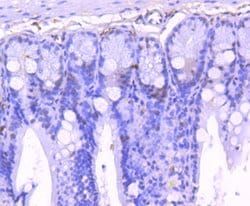
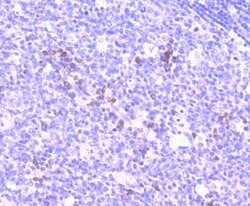
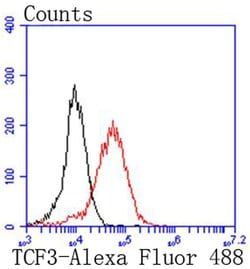
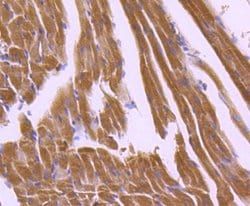
Immunocytochemistry, Immunohistochemistry, Western Blot, Western Blot
Clone
SD2099
Conjugate
Unconjugated
Gene
Atf5
Gene Alias
activating transcription factor 5, Activating transcription factor 5-alpha/beta, activating transcription factor 7, activating transcription factor X, AFTA, ATF5, Atf7, Atfx, BZIP protein ATF7, cAMP-dependent transcription factor ATF-5, Cyclic AMP-dependent transcription factor ATF-5, FLJ34666, HMFN0395, NAP1, NRIF3-associated protein, ODA-10, Transcription factor ATFx, transcription factor-like protein ODA-10
Host Species
Rabbit
Purification Method
Protein A
Regulatory Status
RUO
Gene ID (Entrez)
107503, 22809, 282840
Content And Storage
Store at 4°C short term. For long term storage, store at -20°C, avoiding freeze/thaw cycles.
Form
Liquid
Related Products
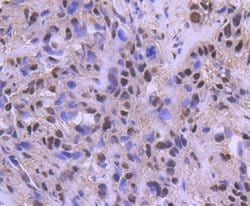
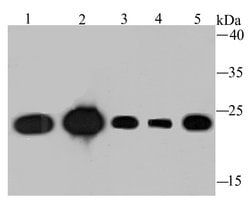
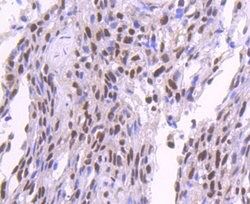
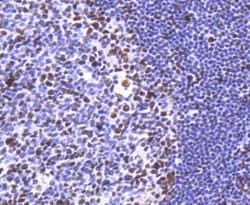
Description
- Recombinant rabbit monoclonal antibodies are produced using in vitro expression systems
- The expression systems are developed by cloning in the specific antibody DNA sequences from immunoreactive rabbits
- Then, individual clones are screened to select the best candidates for production
- The advantages of using recombinant rabbit monoclonal antibodies include: better specificity and sensitivity, lot-to-lot consistency, animal origin-free formulations, and broader immunoreactivity to diverse targets due to larger rabbit immune repertoire
- ATF5 is a protein coding gene
- Transcription factor that either stimulates or represses gene transcription through binding of different DNA regulatory elements such as cAMP response element (CRE) (consensus: 5'-GTGACGT[AC][AG]-3'), ATF5-specific response element (ARE) (consensus: 5'-C[CT]TCT[CT]CCTT[AT]-3') but also the amino acid response element (AARE), present in many viral and cellular promoters
- Critically involved, often in a cell type-dependent manner, in cell survival, proliferation, and differentiation
- Its transcriptional activity is enhanced by CCND3 and slightly inhibited by CDK4
- Important regulator of the cerebral cortex formation, functions in cerebral cortical neuroprogenitor cells to maintain proliferation and to block differentiation into neurons
- Must be down-regulated in order for such cells to exit the cycle and differentiate
- Participates in the pathways by which SHH promotes cerebellar granule neuron progenitor cells proliferation
- Critical for survival of mature olfactory sensory neurons (OSN), directs expression of OSN-specific genes
- May be involved in osteogenic differentiation
- Promotes cell proliferation and survival by inducing the expression of EGR1 sinergistically with ELK1
- Once acetylated by EP300, binds to ARE sequences on target genes promoters, such as BCL2 and EGR1
- Plays an anti-apoptotic role through the transcriptional regulation of BCL2, this function seems to be cell type-dependent
- Cooperates with NR1I3/CAR in the transcriptional activation of CYP2B6 in liver
- In hepatic cells, represses CRE-dependent transcription and inhibits proliferation by blocking at G2/M phase
- May act as a negative regulator of IL1B transduction pathway in liver
- Upon IL1B stimulus, cooperates with NLK to activate the transactivation activity of C/EBP subfamily members
- Besides its function of transcription factor, acts as a cofactor of CEBPB to activate CEBPA and promote adipocyte differentiation
- Regulates centrosome dynamics in a cell-cycle- and centriole-age-dependent manner
- Forms 9-foci symmetrical ring scaffold around the mother centriole to control centrosome function and the interaction between centrioles and pericentriolar material.