PDI Recombinant Rabbit Monoclonal Antibody (JF97-08), Invitrogen™
Manufacturer: Thermo Scientific
Select a Size
| Pack Size | SKU | Availability | Price |
|---|---|---|---|
| Each of 1 | PIMA532542-Each-of-1 | In Stock | ₹ 47,481.50 |
PIMA532542 - Each of 1
In Stock
Quantity
1
Base Price: ₹ 47,481.50
GST (18%): ₹ 8,546.67
Total Price: ₹ 56,028.17
Antigen
PDI
Classification
Monoclonal
Concentration
1 mg/mL
Formulation
TBS with 0.05% BSA, 40% Glycerol and 0.05% sodium azide, pH 7.4
Gene Accession No.
P04785, P07237, P09103
Gene Symbols
P4hb
Immunogen
Synthetic peptide within Human PD1 aa 405-450
Quantity
100 μL
Primary or Secondary
Primary
Target Species
Human, Mouse, Rat
Product Type
Antibody
Isotype
IgG
Applications
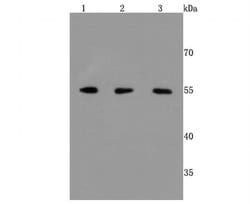
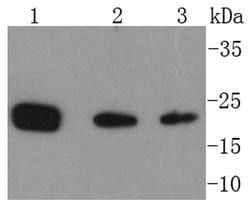
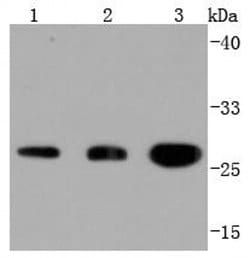
Flow Cytometry, Western Blot
Clone
JF97-08
Conjugate
Unconjugated
Gene
P4hb
Gene Alias
1810041F13Rik, AI661267, CaO19.12595, cellular thyroid hormone binding protein, cellular thyroid hormone-binding protein, CLCRP1, collagen prolyl 4-hydroxylase beta, DSI, Endoplasmic reticulum resident protein 59, Eps1p, ER protein 59, ERBA2L, ERp59, GIT, glutathione-insulin transhydrogenase, I79_002399, LOW QUALITY PROTEIN: protein disulfide-isomerase A2, MFP1, P4HB, p4hb.L, P4Hbeta, p55, p58, Pancreas-specific protein disulfide isomerase, pancreatic protein disulfide isomerase, PDA2, PDI, PDI (E.C.5.3.4.1), PDI1, PDI1P, Pdia1, pdia2, pdia2.L, PDIP, Pdipl, PDIR, PHDB, PO4DB, PO4HB, procollagen-proline, 2-oxoglutarate 4-dioxygenase (proline 4-hydroxylase), beta polypeptide, PROHB, prolyl 4-hydroxylase beta polypeptide, Prolyl 4-hydroxylase subunit beta, prolyl 4-hydroxylase subunit beta L homeolog, prolyl 4-hydroxylase subunit beta L homeolog, prolyl 4-hydroxylase, beta polypeptide L homeolog, prolyl 4-hydroxylase, beta polypeptide, prolyl 4-hydroxylase, beta subunit, protein disulfide isomerase, protein disulfide isomerase (pancreas) like, Protein disulfide isomerase (Prolyl 4-hydroxylase, beta polypeptide), protein disulfide isomerase A2, protein disulfide isomerase associated 2, protein disulfide isomerase family A member 2, protein disulfide isomerase family A member 2 L homeolog, protein disulfide isomerase family A, member 1, protein disulfide isomerase family A, member 2, protein disulfide isomerase PDI1, protein disulfide isomerase, pancreatic, protein disulfide isomerase/oxidoreductase, protein disulfide isomerase-associated 1, protein disulfide isomerase-associated 2, protein disulfide-isomerase, Protein disulfide-isomerase A2, protocollagen hydroxylase, Rho GDP dissociation inhibitor gamma, testicular secretory protein Li 32, Thbp, Thioredoxin-related glycoprotein 1, thyroid hormone-binding protein p55, TRG1, XELAEV_18043753mg, XELAEV_18045582mg, XPDIp, YCL043C, YCL313, YCL43C
Host Species
Rabbit
Purification Method
Protein A
Regulatory Status
RUO
Gene ID (Entrez)
18453, 25506, 5034
Content And Storage
Store at 4°C short term. For long term storage, store at -20°C, avoiding freeze/thaw cycles.
Form
Liquid
Related Products
Description
- Recombinant rabbit monoclonal antibodies are produced using in vitro expression systems
- The expression systems are developed by cloning in the specific antibody DNA sequences from immunoreactive rabbits
- Then, individual clones are screened to select the best candidates for production
- The advantages of using recombinant rabbit monoclonal antibodies include: better specificity and sensitivity, lot-to-lot consistency, animal origin-free formulations, and broader immunoreactivity to diverse targets due to larger rabbit immune repertoire
- Protein disulfide isomerase (PDI) is a multifunctional protein that catalyzes the formation, breakage and rearrangement of disulfide bonds
- At the cell surface, the protein seems to act as a reductase that cleaves disulfide bonds of proteins attached to the cell
- It may therefore cause structural modifications of exofacial proteins
- Inside the cell, PDI seems to form/rearrange disulfide bonds of nascent proteins
- At high concentrations, it functions as a chaperone that inhibits aggregation of misfolded proteins
- At low concentrations, it facilitates aggregation (anti-chaperone activity)
- PDI may be involved with other chaperones in the structural modification of the TG precursor in hormone biogenesis
- It also acts a structural subunit of various enzymes such as prolyl 4-hydroxylase and microsomal triacylglycerol transfer protein MTTP
- Receptor for LGALS9; the interaction retains P4HB at the cell surface of Th2 T helper cells, increasing disulfide reductase activity at the plasma membrane, altering the plasma membrane redox state and enhancing cell migration.